
Protagonists
- Clement Scheidegger - FOC Representative, Mountaineer (Michalis)
- Narinder “Nari” Sodhi - Natural Sciences Student (Ioannis)
- Mauricio Duarte - Geology/Metallurgy Student (Istvan)
- Susan Chen - History Student (Konstantina)
- Father Ludovick Cloutier - Catholic Priest, Religion Lecturer (Tasos)
“Three people don’t just vanish without leaving a mark. A rabbit leaves a mark. A leaf leaves a mark. But those kids — nothing. Like they’d been rubbed out.”
— Joe Harlow, on the road to Rice Hill
Summary
August 16th, 1930. The expedition divides. Clement and Mauricio ride north with Joe Harlow to Rice Hill, where the old driver unfolds a devastating account of the last time he ferried students into the Green Mountains — how three young people walked barefoot into oblivion and left not so much as a bent blade of grass behind. Meanwhile, Nari, Susan, and Father Cloutier fan out across Cobb’s Corners with Blaine and the folklorists, knocking on farmhouse doors and gathering the valley’s strange, sad stories: deer that refuse to walk one ridge, a naked man who wept with joy in a snowstorm before rising into the hills, a library where occult books vanish by night, and a journalist with a photograph of something caught in flight against the moon — a photograph someone tried to burn. By day’s end, the geologists have uncovered Abenaki artifacts beneath the hillside soil, and the folklorists have begun to understand that the darkness in Cobb’s Corners runs deeper than any ghost story.
- Joe Harlow tells Mauricio the full story of the previous expedition — how he drove Daphne Devine, Boyd Patterson, and John Jeffrey to Broken Hill and found their camp abandoned two days later, with no tracks, no struggle, and no explanation. The search dogs sat down and whined. Patterson’s journal described pale lights moving wrong on the hillside. Devine and Jeffrey were never found.
- Harlow warns that the birds don’t sing at Broken Hill. Deer go around it. He advises the students to stay away.
- Blaine tells Clarissa Thurber, “I need you intact” before she departs for Rice Hill — another flash of possessive fixation on her physical well-being.
- Clement confronts the snickering students in the truck bed — Gibbons, Higgins, and Thurber — who mock his age and weight. He silences them with quiet authority.
- At Rice Hill, the survey team finds magnetite (lodestone) but no pasquallium. Block discovers a petroglyph under a rocky overhang — human figures fleeing a strange, oversized bird-like creature.
- Mauricio identifies postholes from an Abenaki dwelling. The team excavates arrowheads, carved bone rings, and a corroded metal pin — evidence of a settlement predating Cobb’s Corners.
- The folklorists visit Ed Tanner, a farmer whose dog Bess refused to go near Broken Hill and whose chickens never look toward the south ridge. He tells them the Abenaki left these mountains — and something drove them out.
- Marion Green shares her grandfather’s story: a naked man found in a January snowstorm, smiling and weeping, who spoke of “the garden inside the mountain” before his footprints ended in mid-air.
- At the Cobb’s Corners Library, Miss Carruthers reveals that occult and folklore books keep being stolen. Nari notices Miss Caruthers niece Amanda Wells acting suspiciously when witchcraft is mentioned and arranges to meet her privately the next day.
- Father Cloutier discovers, in the Gazette’s archives, an alarming pattern of young people dying in Cobb’s Corners over the past twenty years — disease, accidents, and at least one exsanguinated body.
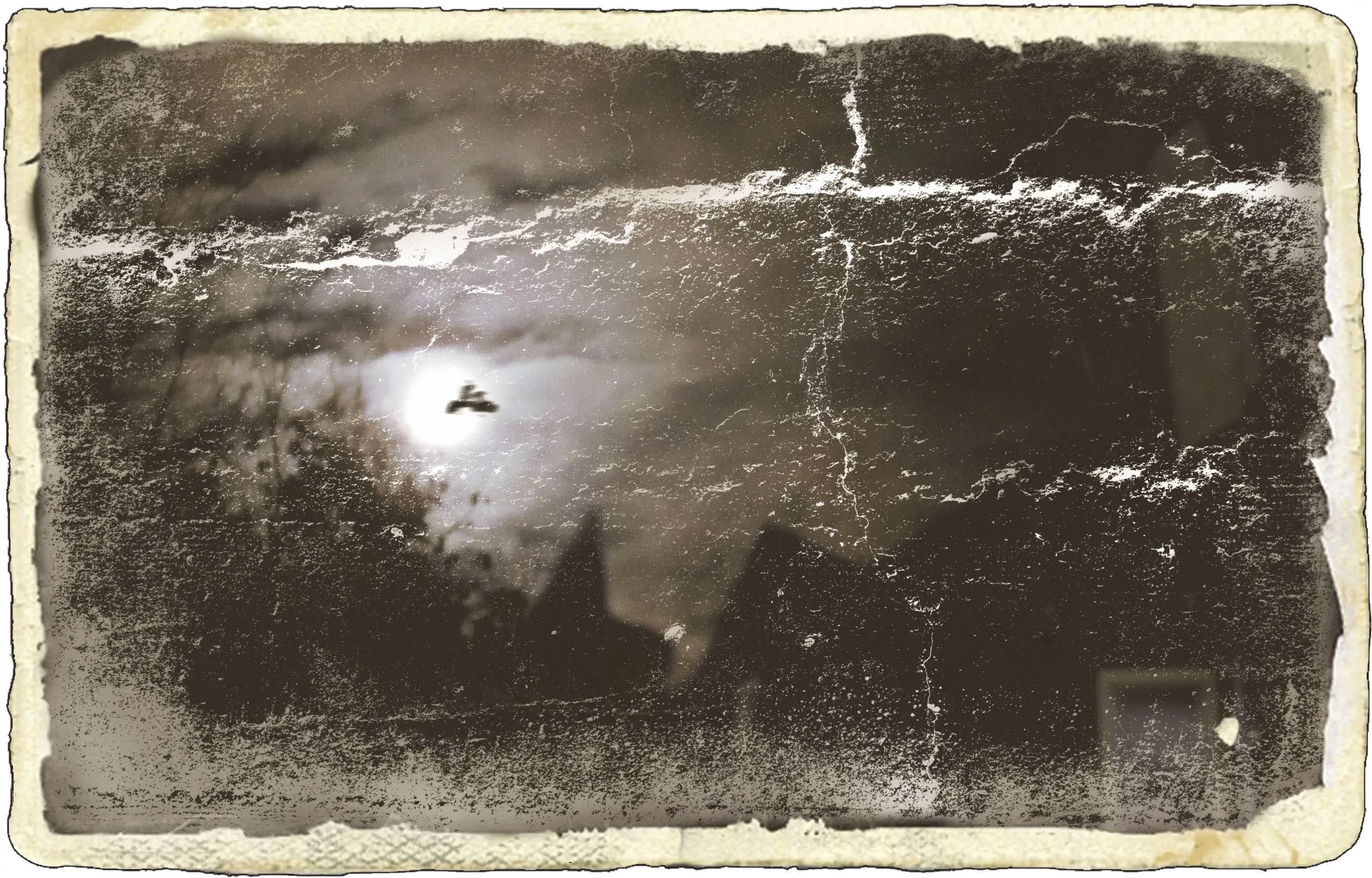
- Richard Wendell shows the investigators a grainy photograph of something flying against the moon near Broken Hill. He says Deputy Cutter set fire to his darkroom to destroy the evidence and threatened him into silence.
- Huge storm clouds gather over the Green Mountains as both groups return to the Maclearan farmhouse.
The Parting of Ways
Eight o’clock on the morning of August 16th, and the heat was already building. The air hung thick and wet over the Maclearan farmhouse, promising a scorcher. Joe Harlow arrived in the Ford AA truck, squinting at the world through eyes that seemed permanently half-shut, rolling a cigarette with one hand while the other rested on the wheel. He had the look of a man who had done too many things in his life and remembered all of them.
Blaine laid out the plan with brisk authority. Group One — the survey team — would ride with Harlow to Rice Hill and spend the day prospecting. Group Two — the folklorists — would take the Chevrolets into Cobb’s Corners and begin interviewing locals. He, Blaine, would accompany the folklorists today, introducing them around town before rotating to the survey group on subsequent days.
Before they left, Blaine pulled Clarissa Thurber aside. Clement, climbing into the truck, caught fragments of the exchange. Blaine told her to be extremely careful at Rice Hill. “I need you intact,” he said. The words were not tender. They carried the weight of a man issuing an instruction about the care of fragile equipment.
Clement said nothing. He tucked his Alpenstock beside the crates and settled in for the drive.
The Driver’s Tale
The road to Rice Hill wound through the Green Mountains along the Gismend Road, crossing the Deerfield River and climbing into terrain that grew rougher with every mile. Harlow drove with the ease of a man who knew every pothole by name, one hand on the wheel, the other occupied with the perpetual task of rolling cigarettes. He could roll and light one without ever taking his eyes off the road, and he chain-smoked with the mechanical regularity of a man who had given up counting how many he consumed in a day.
Mauricio, riding in the cab, asked about the previous expedition. About Daphne Devine and the others. Harlow was quiet for a long moment. Then he spoke.
He had been the driver last year, too. Same truck, same road. He dropped them at the foot of Broken Hill on a Monday in September — Daphne Devine, Boyd Patterson, and John Jeffrey. Blaine wasn’t with them; he had broken his arm falling down stairs in Arkham the night before. Just the three.
Miss Devine, Harlow said, had a way of looking at you like she was reading two pages ahead. Sharp. The star of the program. Patterson was quiet, kept a journal, wrote in it every spare minute — sat down on a rock and started writing before the tent was even up. Jeffrey was the geology fellow, couldn’t stop talking about rocks. Harlow had told him the only rock that mattered was the one you trip over.
Miss Devine had found something on the first trip. An old burial mound, she reckoned. Native. She wanted to dig proper this time.
Harlow unloaded the heavy crates at the base of the hill. There was a flat spot there, sheltered from the wind by the ridge. Miss Devine couldn’t lift a survey tripod to save her life. Jeffrey was hitting rocks with his little hammer before the last crate was off the truck. Patterson sat down with his journal right where he stood. And Miss Devine — Harlow paused — she was already walking the base of the hill, hands in her jacket pockets, studying the ground like it owed her money.
Then she stopped. Looked up — not at the ridge, at the sky. Stood there staring for ten seconds. Turned to Harlow, smiled, and said, “Thank you, Mr. Harlow. We’ll be fine.”
She said it too fast. Like she was trying to convince herself.
He drove back down the road. That was the last time he saw any of them.
Wednesday morning. Same road, same truck. The camp was still there. Tents standing, though the door flap of one was undone and waving in the breeze. The fire pit was cold — hadn’t been lit since Monday night. Food stores barely touched, most of it still in the crate, right where he had set it down. Patterson’s journal sitting on a flat rock, open. The last entry was half-written. The pen lying next to it, like he had just set it down for a moment. Jeffrey’s rock hammer stuck in the ground. And nobody home.
No sign of struggle. No blood. The boots were all still there. Three people don’t walk barefoot out of a campsite in the middle of the Green Mountains and not come back. September. The ground is cold. The rocks will cut your feet to ribbons.
Harlow walked the site twice. Checked the tree line. Not a track. And he knew tracks — he had trapped these hills for six years. Not a broken branch. Not a bent blade of grass pointing which way they went. Three people don’t just vanish without leaving a mark. A rabbit leaves a mark. A leaf leaves a mark. But those kids — nothing. Like they’d been rubbed out.
He drove straight back to Cobb’s Corners and told Sheriff Spencer. The sheriff put a party together the next day. The dogs wouldn’t track. Just sat down at the edge of the campsite and whined. Wouldn’t go near the hill. Had to be dragged away. Spencer said it was bad handling. But Harlow had seen those dogs track a raccoon through three feet of snow. Those dogs weren’t confused. Those dogs were scared.
Patterson turned up a week later at the foot of the Green Mountains. Five miles from Broken Hill, with no road between them. Broken bones. They said he fell. Maybe he did. His journal wasn’t with him — the half-finished one from the rock. It wasn’t about rocks or surveys. Harlow had seen it before Spencer bagged it. Patterson was writing about lights on the hillside at night. Pale, moving wrong, like they were swimming through the air instead of shining from it.
Devine and Jeffrey never turned up. Not a button. Not a bone. The search went on for two weeks before they called it. Then young Blaine showed up from Arkham with his arm in a cast, demanding to be taken to the site, blaming himself. He walked that hill for three days by himself. Wouldn’t let anyone go with him. Came back looking ten years older. Wouldn’t talk about what he found, or what he didn’t find.
Harlow lit another cigarette. He pulled tobacco pouch and rolling paper with his one free hand, the truck never wavering on the rough road. The smoke curled out through his nose.
You want to know what I think happened? I think they found something on that hill. Or something on that hill found them. And I think whatever has been up there has been there for a long, long time. Longer than Cobb’s Corners. Longer than Vermont. I’ve lived these hills my whole life. Farmed them, mined them, trapped them, drank my way through every back road in this county. And I will tell you this for free: Broken Hill is the only place in the Green Mountains where the birds don’t sing.
You go up there, stand at the base, close your eyes, and listen. Nothing. Not a sparrow, not a jay, not a crow. They go around it. The deer go around it. Even the bugs go around it. Everything with blood in its veins goes around Broken Hill.
Now, you want a piece of friendly advice from an old man who’s been driving these roads since before your professor was born. Don’t go to Broken Hill. Stay on the roads. Do your surveys. Go home to Arkham. Those kids were smarter than you and better prepared.
He lit the cigarette, fixed his eyes on the road, and said no more.
Mauricio sat in silence for a long time after that. Presently he mentioned that he had seen something the night before — glowing yellow eyes near the tree line, small, about thirty centimeters off the ground. Harlow glanced at him and shrugged. Probably an owl. Probably nothing. He reached under the seat and produced a bottle of whiskey, handing it to the young student without ceremony. Mauricio took a long pull and passed it to Block in the back.
Clement, riding in the truck bed with the crates and the snickering students, was oblivious to the conversation in the cab. He was occupied with more immediate concerns. Louis Gibbons, Harry Higgins, and Clarissa Thurber had seated themselves as far from the Swiss man as the truck allowed, and they were not being quiet about it. Higgins whispered behind his hand, and the other two laughed and looked back at Clement with the guilty delight of children who have discovered that adults have vulnerabilities.
“He must be drinking a lot of wine. That’s why his belly is so big.”
“He even has a cane. He cannot walk.”
“Can’t you see how old he is? He must be a hundred years old or something.”
Clement straightened on the crate where he sat. “I am fifty-two years old, and I like beer, not wine. And this is not a walking stick. This is my Alpenstock.” He said it calmly, in a voice that had commanded expedition teams in the Alps and the Andes. The laughter stopped. The students looked at their shoes for the rest of the drive.
Rice Hill
The truck pulled off the road at a plateau below Rice Hill — a broad, rocky expanse carpeted with scrub grass and low bushes, open to the sun on all sides save one, where a rocky overhang offered the only shade. The mountains rose on every horizon. The air was hotter here than in the valley, close and still, and within minutes of stepping out of the truck, their shirts were sticking to their backs.
Clement arranged the work. Louis Gibbons, the botanist, pleaded that his pianist’s hands were too delicate for manual labor. Clement told him to clear the underbrush and set up camp. Gibbons picked up a small brush and declared himself an expert at cleaning rocks. The others took up pickaxes and surveying tools.
Harlow finished unloading the equipment, declined Clement’s invitation to stay, and announced he would return at seven. “Watch yourselves,” he said. “In case some bear appears. If a bear shows up, stand tall. Make yourself look bigger. That’s the secret.” He touched the brim of his tatty straw hat, climbed into the truck, and drove away down the mountain road.
The hours passed in heat and labor. Mauricio, working a patch of rocky ground, heard a different sound through his pickaxe — not rock, not dirt. Something else. He knelt and brushed away the soil to reveal a dark-colored ore, black and dense. He called Clement over.
Magnetite. Lodestone. The region was known for it. Not interesting, not pasquallium, but a legitimate find nonetheless. Clement praised the young geologist’s work with the restrained enthusiasm of a man who understood that patience was the first tool of science.
Mauricio wiped the sweat from his forehead and kept digging. The sun climbed. Block took his shirt off and swung the pickaxe with the mechanical fury of a football player who had been told that rocks don’t tackle back. Clarissa stayed near the equipment crates, watching, her chemistry textbook open on her knee.
Sometime after noon, during a rest in the shade of the overhang, Block stood up from where he had been sitting and stared at the rock wall behind him. His eyes were wide. “Hey,” he called. “Come here. Quick.”
Under the overhang, half-hidden by decades of lichen and grime, something had been carved into the stone. Not drawn — carved, with deliberate strokes, into the living rock. Block began scraping away the growth with his fingers.
A petroglyph. A scene of stylized human figures running, their limbs angular and panicked, fleeing from something above them. Above the figures, a strange bird-like shape spread its wings — too large, too wrong, its proportions off in ways that were hard to pin down but impossible to ignore. Some of the human figures were depicted shooting arrows at the creature. A battle. A hunt. Or a memory of something terrible that had happened on this hillside a very long time ago.
None of them could identify it. Mauricio copied the image into his notepad as accurately as his shaking hands allowed. Clement photographed it with the expedition camera. Block stood back and looked at it for a long time without speaking.
“Not our business,” Clement said eventually. “We keep digging.” But he glanced back at the petroglyph once more before turning away.
A few hours later, Mauricio found something else. Near a small stream that ran along the edge of the plateau, he noticed circular discolorations in the soil. Four of them, arranged in a rough rectangle, each several meters apart. Postholes. The remnants of a dwelling. Higgins, pressed into service with his geology training, confirmed it. An Abenaki structure, buried here under the grass and the years.
They dug. The afternoon turned long and golden. Arrowheads emerged from the soil, carved from dolomite. Carved bone rings, ten centimeters in diameter. A heavily corroded metal pin, its purpose unclear. The artifacts were collected, catalogued, and photographed with the care that academic procedure demanded and the excitement that academic procedure could not suppress. Someone — it may have been Mauricio, it may have been Clement — said that Professor Harrold would be pleased.
At seven o’clock, Harlow returned. The sky behind the mountains had darkened — not with sunset, but with clouds. Huge, black, rolling thunderheads were piling up over the Green Mountains, and the air had turned close and electric. A summer storm was coming, and it was going to be a bad one.
Mauricio asked Harlow whether he could take them somewhere else tomorrow. Somewhere like Broken Hill. Harlow shook his head. Blaine was the supervisor. He went where Blaine told him. Mauricio dangled a dollar bill. Harlow looked at it, looked at the young student, and said, “Let’s discuss it tomorrow.” Then he fixed his eyes on the road and drove them home through the dying light, the first distant rumble of thunder rolling across the valley behind them.
The Folklorists
While the geologists baked and dug, the folklorists drove into Cobb’s Corners under Blaine’s guidance. He shepherded them to Jim’s Grill, spread a map on the table, and marked houses with a pencil. Ed Tanner, half a mile south. Marion Green on the eastern edge. The Walls family. Visit them all. Collect what stories they could. Meet back here at the end of the day.
The group split into teams of three. Nari, Susan, and Father Cloutier formed one unit — the investigators proper, with their notepads and their questions and their phonograph, which Susan could not, despite repeated attempts, figure out how to operate. The needle was not engaged. The cylinder spun, but nothing was recorded. Nobody noticed.
Before the groups separated, Nari tried once more to reach Jason Trent. The boy sat in the back of one Chevrolet, his nose buried in The Witch-Cult in Western Europe, the same Margaret Murray volume he had been reading since Arkham. Nari asked him about the book. Trent clutched it to his chest and refused to show her. When she pressed, asking if it discussed India — she came from India, she had her own traditions — he flushed and said, “It talks about Europe. Do you know any place in Europe? It doesn’t talk about London.” He moved to the far side of the car and held the book like a shield.
Nari let her hand dip into her bag and produced the mandrake root — the one she had taken from Trent’s secret digging spot in the sugar maple forest. She held it where he could see it, then tucked it away before anyone else noticed. Trent’s eyes locked onto it. She would explain later, she told him. Not now.
In the other car, Susan sat with Terrence Laslow, who complained about the heat, his wrinkled cashmere, and his mother, who was not answering the telephone. He asked Blaine why he had come on this trip. Blaine said something about proving himself. Susan asked whether he had known the missing students. He had seen Daphne. That was all.
Blaine himself seemed restless. He outlined the interviews, suggested locations, handed out names — and then retreated, telling the investigators he would not interfere. He wanted them to learn as much as they could on their own. The students exchanged glances. Blaine’s helpfulness had the quality of a man ticking items off a list.
Ed Tanner
The first visit was to Ed Tanner’s farmhouse, half a mile south of town — a modest whitewashed building with a sagging barn, a feral vegetable garden, and a rusted plough sitting in the tall grass like a monument. Chickens wandered the yard. A man in his early sixties stood on the porch, leather-skinned and gnarled, wearing sweat-stained suspenders and a straw hat. His left hand was missing two fingers.
Father Cloutier introduced them. Students from Arkham. Here to ask questions. Tanner looked them over with the flat appraisal of a man who had been promised nothing by the world and had received less.
“You want to lose your life foolishly, like them?” He meant last year’s students.
Nari, with her gift for warmth, softened him. They were here to continue the research, she said. To honor the work of those who had come before. Tanner grudgingly admitted them to his porch. He sat down in a chair that groaned beneath him, and he told them what he knew.
It wasn’t much — or rather, it was too much. Thirty years he had farmed this land. And he would tell them something he had never told a soul outside the valley. Every fall, around the first frost, the deer came down from the high country. Natural. Always had. But they came down the east slope, the west slope, the north face. They did not come down the south ridge. Not ever. Not one deer, not one track, not one pile of scat. The south ridge ran up past Broken Hill.
Deer are not smart animals. A deer will walk into the side of a moving truck. But they won’t go up that ridge.
And five years back, he had a dog. Bess. A coonhound, smart as a whip. One night she took off after a scent and headed due south, toward that ridge. He called and called. She stopped at the tree line, a quarter mile from the base of the hill. Stopped dead. Rigid. Every hair on her back standing up. Whimpering. This dog that once chased a black bear up an oak tree. She came back with her tail between her legs and never went south again. Wouldn’t even look in that direction.
If the animals won’t go, you shouldn’t go neither.
Nari noticed the chickens. Seven or eight of them, scratching and pecking in the yard. She watched them for a long time. None of them — not a single one — looked toward the south. Not toward Broken Hill. They moved in strange, circumventing patterns, always turning away from that direction, as though an invisible wall stood between them and the ridge.
Tanner told them about the Abenaki — peaceful people, hunters and gatherers, who had lived in these mountains for centuries before vanishing. Some said they moved closer to the coast. Others said something drove them out. Sheriff Spencer had Abenaki blood, Tanner mentioned. And the previous sheriff had died — a cow stepped on him, they said.
They asked about Sarah Maclearan. Tanner knew the stories. He knew about the grave robbery, the missing body, the dead calf in the coffin. He didn’t believe in ghosts. He didn’t know what to believe. He just knew that something was up there, and it wasn’t natural.
Marion Green
The second visit was to a tidy house on the eastern edge of town, with white window boxes full of geraniums, an overgrown rose arbor, and a swept path leading to a porch where everything spoke of a war being waged — successfully, for now — against entropy.
Marion Green met them at the door. A wiry woman in her late fifties, with steel-grey hair pulled back in a severe bun and sharp blue eyes behind round spectacles. She wore a dirt-stained apron and carried pruning shears in one hand. She had been tending her roses.
She recognized them at once. “You’re the new students. I heard you were coming.” She seated them on the porch and brought out cake — homemade, still warm — and strong coffee. Father Cloutier, who had not eaten since dawn, accepted both with the quiet gratitude of a man who understood that hospitality was its own form of grace.
Marion had not spoken to last year’s students, but she had seen them come through town. Patterson had stopped at her door to ask for directions. She had given him a slice of pie. He said it was the best he ever had. Such manners. And now he was dead on a mountain. For what? Rocks. Dirt.
She told them a story from her grandfather’s time. He had found a man once, wandering the road in the middle of the night. This was deep winter, January, the middle of a snowstorm. The man was stark naked. Alive, barely. Frozen solid in places. But his eyes were open and he was smiling.
Her grandfather brought him inside. Warmed him by the fire. And the man kept saying the same thing, over and over: “It’s so beautiful up there. It’s so beautiful. I want to go back.”
Her grandfather asked where he had come from. The man pointed toward the hills. “They showed me the garden. The garden. Inside the mountain.” Then he started crying — not sad crying, happy crying, tears rolling down his frozen face, laughing and sobbing at the same time.
Her grandfather went to get the doctor. When he came back, the man was gone. Front door wide open. Snow blowing in. Bare footprints in the fresh powder leading straight toward the hills. Her grandfather followed the tracks as far as the tree line. Then the tracks just stopped. Two feet of fresh snow, and the prints ended in the middle of a clearing, as though the man had been picked up.
Her grandfather never talked about it after that. But he stopped letting his daughters play outside after dark. Not just that winter. Every winter. For the rest of his life.
The investigators sat in silence. The roses nodded in the warm air. Susan put down her cake.
They asked about Sarah, about the grave, about the missing body. Marion didn’t believe in ghosts. Didn’t believe Sarah was a vampire, despite what Dr. Perry said — the man had been spreading that rumor for years, ever since he saw a moving picture about vampires in New York and let his imagination run away with him. The previous reverend, Matthew Hill, had died of a heart attack at seventy. The new one, Earl Wilson, was a fire-and-brimstone type. Strict with the children. The church was the First Baptist Church of the Divine Ascension.
Marion served them another slice of cake and asked if they were eating properly. The question was genuine, and it was the most unsettling thing she had said all afternoon.
The Library
The Cobb’s Corners Public Library was a single-story wooden building, weathered brown, with two green metal benches out front and windows that looked out on a ground-level porch. Inside, chaos reigned. Books were stacked on every surface, piled on the floor in leaning towers, crammed into aisles that had been reduced to narrow footpaths through a labyrinth of paper and binding. The air smelled of old pages and dust.
Behind the crowded desk sat Mabel Carruthers, the librarian — a middle-aged woman with grey hair in a tight bun and a whispering voice that never quite rose above the level of the stacks. With her was her niece, Amanda Wells — a young woman of about seventeen, with lank black hair, a bad case of acne, crooked teeth, and brown eyes, one of which had a disconcerting tendency to wander. She wore a voluminous grey dress with long sleeves and a high collar, and she moved among the shelves with the nervous energy of someone who was cataloguing everything she saw.
Nari asked about folklore, local myths, Abenaki legends. Miss Carruthers shook her head. She used to stock books on those subjects, she said. But every time she got one, someone would steal it. She had stopped trying. She reported the thefts to the sheriff, but nothing ever came of it.
Nari noticed Amanda. The girl was watching — not openly, but sidelong, the way a person watches when they are interested in being asked a question but afraid of being seen to want it. When Nari mentioned witchcraft, Amanda’s wandering eye flicked toward her aunt, and she busied herself with reshelving a book in a section where it clearly did not belong.
Miss Carruthers explained her filing system — the Carruthers Card Catalogue System, a method of organization based on, among other things, the texture and smell of the books. It was impenetrable to outsiders. With her help, they found a history of Cobb’s Corners. Father Cloutier donated three dollars to the library, which Miss Carruthers accepted with a whispered thank you and slid into a desk drawer.
Nari approached Amanda while the others browsed. She asked about India, about okra curry, about religions — her own faith, Christianity, the many things people believed. Amanda listened with that awkward, half-hidden interest of a girl who had been told to stay quiet and was deciding whether to disobey. She denied any interest in witches or ghosts. She said she did what her mother told her. But her smile, when it came, was not the smile of someone who was telling the truth.
Nari arranged to meet her the next day. She pulled the mandrake root from her bag and held it up — just for a moment, just where Amanda could see. The girl’s eyes widened. Nari tucked it away and said she would explain tomorrow. Amanda nodded, once, very quickly, and went back to shelving books in the wrong section.
The Gazette
The last stop of the day was the Cobb’s Corners Gazette — a two-story building that served as both office and home for Richard Wendell, the reporter who had ambushed them outside Jim’s Grill on their first day. His office occupied the lower floor, and it was a disaster of notes, photographs, newspaper clippings, and yellow plaster walls smothered in layers of maps and old front pages.
Wendell was delighted to see them. Sarah’s Shade was his favorite topic — always sold papers, he admitted without shame. He produced a stack of back issues and told them to read as long as they liked.
Father Cloutier, Susan, and Nari spread the newspapers across the floor and began to read. What they found was worse than any ghost story.
Over the past twenty years and more, young people in Cobb’s Corners had been dying at an alarming rate. Disease, accidents, falls from cliffs. One boy was found exsanguinated — drained of blood — with no wound and no explanation. A girl had been found dead in a barn; the official report said she had fallen on a knife she was running with. Year after year, at least one young person between the ages of eight and eighteen died in this small Vermont town, and every time, the cause was something that sounded plausible and felt wrong.
Wendell’s articles followed a pattern. Each account of a young person’s death ended with the same question, printed in bold: “Is Sarah’s Shade really a vampire?” He was keeping the myth alive because the myth sold newspapers. But the deaths beneath the headlines were real.
Among the clippings, Father Cloutier found an interview with a local man who claimed to have seen something on a mound near the base of Landin Mountain. Sometimes, when there were no stars in the sky, a huge dog would appear on the mound and howl. The dog was as big as a bull, with glowing green eyes, and its howl was mournful beyond bearing. Pilgrims — early settlers murdered by the Wampanoag — were buried in that mound, the man said. The dog was their guardian. He had made the sign of the cross and said the Lord’s Prayer, and the thing had vanished. But others still heard it howling, on nights when the sky was empty.
They asked Wendell about his own story. The reporter leaned forward, lowering his voice, and told them about the night six months ago when he had been testing a new photographic emulsion — a mixture of his own devising, designed to capture images in darkness. Walking outside of town, he had heard a buzzing sound above him. He looked up and saw something flying in the night sky. Something fast. Something wrong.
It flew in front of the moon, and he took a photograph. Then he ran home and stuck the camera under his desk. He fell asleep. In the early hours of the morning, he woke to the sound of the front door closing and the smell of smoke. His darkroom was on fire.
He put it out. Barely. And when he looked through the window, he saw Deputy Cutter staring in at him.
The next day, Wendell went to the jail and confronted the deputy. Cutter didn’t deny being there. He said he had seen smoke and come to investigate. But he also told Wendell something else: “Not only do you not have any evidence, who do you think people are gonna believe? Everyone knows you’re a liar and a troublemaker.”
Wendell still had the photograph. The camera had been under his desk, not in the darkroom, and the fire hadn’t reached it. He pulled it out and showed it to them.
A grainy, blurred image. The moon, large and pale. And in front of it, a dark silhouette — something with wings, something large, something that should not have been flying at night in the Green Mountains of Vermont. It could have been a bird. It could have been a bat. It could have been anything, which was precisely the problem, because the image existed at all, and someone had tried to destroy it.
The investigators studied the photograph in silence. The late afternoon light slanted through the Gazette’s dirty windows, and the stacks of newspaper whispered around them like confessions.
They asked Wendell about Cutter. The deputy was twenty years old. His parents were dead. He lived alone. He was handsome, friendly, trusted by the town. And he was never seen with a girl. Not once. Not ever. In a town this small, people noticed that kind of thing.
Wendell looked at each of them. “You’re the only ones who still care about your missing friends,” he said. “That’s why I’m telling you this.”
Outside, the sky was turning dark. Not with evening — with storm. The same thunderheads that had pursued the geologists across the valley were rolling over Cobb’s Corners now, black and low and heavy with rain. The investigators gathered their notes, their borrowed newspaper clippings, their borrowed book, and their borrowed dread, and drove back to the Maclearan farmhouse through the gathering dark.
Next: The storm breaks over Cobb’s Corners. The investigators return to their work — to the hills, to the town, to the stories that keep multiplying. But something else is stirring in the valley. Something that has been patient for a very long time, and is no longer willing to wait.