
Protagonists
- Clement Scheidegger - FOC Representative, Mountaineer (Michalis)
- Narinder “Nari” Sodhi - Natural Sciences Student (Ioannis)
- Mauricio Duarte - Geology/Metallurgy Student (Istvan)
- Susan Chen - History Student (Konstantina)
- Father Ludovick Cloutier - Catholic Priest, Religion Lecturer (Tasos)
Things With Teeth
“You’ve been lying to us all night. Two is not an odd number. And what did you say earlier? There have to be an odd number. I know my math — I study science.”
— Nari Sodhi, in the clearing
Summary
Night falls on the Maclearan farmhouse, and with it comes Jason Trent’s desperate plan. Armed with a passage from Margaret Murray’s The Witch-Cult in Western Europe, the strange boy leads Nari, Susan, and Mauricio into the sugar maple forest at midnight to summon a “familiar” — a protective spirit drawn from the pages of his book. What answers the call is not a servant but a horror: rat-things with tentacled snouts, rows of translucent needle teeth, and bone knives clutched in tiny clawed hands. The investigators flee through the dark wood as dozens of the creatures pour from the undergrowth, and they learn, gasping and bleeding at the edge of the treeline, that whatever lives in the forest does not cross into the open ground. Before the night is over, Jimmy Maclearan staggers from the dark demanding they leave his dead wife’s house, a terrible shared dream visits the sleepers, and the investigators begin to understand that the darkness in Cobb’s Corners has teeth — and it has been watching them since they arrived.
- Susan discovers the flower bed behind the farmhouse is large enough to hold a human body and suspiciously well-tended for an abandoned property. She plans to dig when the rain softens the ground.
- Jason Trent convinces Nari, Susan, and Mauricio to join him in a midnight ritual to summon a “familiar” — a protective spirit described in The Witch-Cult in Western Europe, page one hundred and thirteen.
- Clement follows at a distance but is discovered; he pretends to take a night stroll and eventually creates an awkward enough situation that the younger group presses on without him.
- Trent draws a ritual circle in the forest clearing, places the mandrake root in the center, pours milk, and recites: “I bind thee to our service, wake and answer. I give thee name Chilly, and thou shalt be ours.”
- Yellow eyes appear in the darkness — first two, then more. The creatures that emerge are rat-like, the size of small dogs, with tentacled snouts concealing rows of needle-thin teeth. One carries a bone knife.
- Mauricio shouts “Rapido!” and runs. Trent — who peed himself — flees first. Susan drags Trent to his feet when he stumbles. The creatures pursue through the trees, climbing and leaping from branch to branch.
- One creature blows a dart that embeds in a tree trunk inches from Nari. The things stop at the forest’s edge — fifty pairs of yellow eyes watching from the shadows before dissolving back into the sugar maples.
- The book — Trent’s copy of Murray — is left behind in the forest, along with his backpack.
- Jimmy Maclearan appears at the campfire, drunk and belligerent, demanding the students leave “Sarah’s house” and stay away from “her flowers.” He throws a whiskey bottle into the fire. His voice cracks when he speaks her name. Blaine eventually leads him away.
- The group sleeps. Nari, Susan, and Mauricio share a terrible dream: absolute darkness, a buzzing that becomes words, visions of twisted oaks with fungoid growth, a city of blue marble, humanoid shapes dancing around green flames, cylindrical towers lit by sickly yellow orbs — and finally a clearing in a sugar maple forest, broad daylight, no birds singing, things moving nearby, and a woman screaming.
- Blaine takes Group A to Rice Hill and shows intense interest in the petroglyph site, excavating more arrowheads and bone rings. Clement feigns illness to stay behind.
- Clement and Father Cloutier retrieve the book from the forest at dawn. Clement discovers small paw prints and broken branches leading north, away from the farmhouse — a trail he intends to follow.
- Nari and Clement break into Blaine’s locked room through a window. They find three bottles of moonshine, a few clothes, and a photograph: a portrait of Daphne Devine, turned face-down, handled so often the edges are soft with wear. Nothing else.
- Group B visits the First Baptist Church of the Divine Ascension. Reverend Earl Wilson — scarred, imposing, fire-and-brimstone — has been in Cobb’s Corners only a short time and offers little useful information.
- In the church cemetery, Susan finds Sarah Maclearan’s grave, untended for years, and confirms a pattern of young people dying in Cobb’s Corners — graves of children and teenagers stretching back more than twenty years.
- Mauricio telephones Deputy Cutter and asks to see Patterson’s journal.
- Clement reveals to Father Cloutier that he carries a service pistol from the Great War. The two men agree to investigate the creature tracks together.
The Book and the Flower Bed
The evening brought the expedition back under the Maclearan roof, tired and fractious. Black clouds rolled across the Green Mountains, pressing the heat down into the valley until the air was thick enough to chew. Thunder grumbled in the distance. A summer storm was gathering.
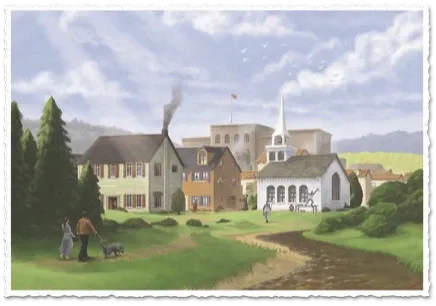
Father Cloutier settled in a corner with the library book he had borrowed — a history of Cobb’s Corners, printed and proper, not some cultist’s handbook. He read aloud the passages that mattered. The town was chartered in 1787 by farmers from New Hampshire, led by Franklin Cobb. The valley was fertile beyond all expectation for Vermont, where the soil was usually thin and granite-rich. The Gismend River ran through it, and the farms produced sweet corn and grain enough to earn the nickname “Breadbasket of Vermont.” A prosperous place, by all accounts. A Rockwell painting come to life.
But in 1790 — three years after the charter — the crops failed. The soil gave out. The farmers despaired. And then, according to the book, something happened. “Some residents began seeking unconventional means to restore the valley’s fertility.” The text was circumspect — a historian’s politeness around matters that might embarrass the living. The soil became fertile again. The recovery was attributed to “Blessings of the Land itself” and “the intercession of Divine Providence.” The book moved on. Father Cloutier did not.
Clement listened with the half-attention of a man who had heard too many origin stories in too many mountain towns to be impressed by any of them. What caught his ear was the word “unconventional.” Farmers did not use that word. Historians did not use that word unless they were hiding something.
Susan, meanwhile, had found her own mystery. She had been circling the flower bed behind the farmhouse — the same impossible riot of violets, daisies, buttercups, and lilacs that Nari had sketched on the first day. In a property where everything was falling apart — collapsed barn, thigh-high grass, cracked windows — this one patch of earth was perfectly, lovingly maintained. Weeded. Tended. The only ordered thing on the entire property.
She began scraping at the edge with her fingers. The bed was the size of a grave. It would hold a person.
Someone — she could not say who — was coming here in secret to tend flowers over a plot of earth large enough to bury a human body. Susan decided to wait for the rain. Wet soil would be easier to dig. She told no one outside her circle.
The Boy and the Ritual
Jason Trent found Nari as the evening deepened and the first drops of rain began to patter on the roof. He was agitated, barely able to hold still, his thick glasses catching the lamplight. The mandrake root — the one Nari had taken from his secret digging spot in the forest — he wanted it back. Not for idle purposes. He had read something. Something important. In his book. The Witch-Cult in Western Europe by Margaret Murray. Page one hundred and thirteen.
Witchcraft, he explained in a breathless tumble of words, was a surviving pre-Christian organized pagan religion. Covens of thirteen. Monthly gatherings called Esbats. Seasonal Sabbats. Witches had spiritual servants bound to them — familiars — that sometimes took physical form as animals or objects. And the book described a ritual to summon one. A protective servant that would follow and guard them. Tonight was the night. The moon was half-full. The book was very specific about the half-moon.
Nari listened with the patience of a woman who had grown up around holy men and recognized the fervor of true belief when she heard it. She did not believe a word of it. But she was curious about what Trent would do, and she was not about to let him go into the forest alone. She told him she would come. She told him she was bringing friends.
Clement was the first person she told. The Swiss man listened, his face unreadable in the dim light, and stated simply that he would follow at a distance. If things went well, he would remain hidden. If they did not, he would intervene. He would be carrying his rock-climbing hammer.
Susan was next. Then Mauricio, who had heard about Trent’s book and was frankly terrified, but who agreed to come when Nari pressed him — partly for the mandrake root, which she still held, and partly because Clement would be nearby.
They agreed to meet at the forest’s edge near midnight.
The Drunken Widower
Before the ritual could begin, the night delivered an interruption.
The campfire burned outside the farmhouse, and around it gathered what remained of the waking. Blaine had produced a bottle of whiskey and was sharing it with Roderick Block, who had shown him the petroglyph drawing from Rice Hill. Blaine’s face had flushed when he saw it — a sudden, involuntary reddening that turned his sardonic features into something almost hungry. He asked where they had found it. He said it was very interesting. He said he would come to the site tomorrow.
Harry Higgins and Louis Gibbons were singing a song by the fire. Clarissa Thurber had gone to bed early, claiming exhaustion. Terrence Laslow was weeping in the house about having to sleep on the floor.
And then a figure emerged from the dark.
He was large — well-built, broad-shouldered, muscles visible through his stained shirt. His face was a ruin of leather and wrinkles, weathered beyond his years, with long brown hair hanging lank beneath a New York Yankees cap. He wore dirty jeans and carried an unlabeled bottle of moonshine. He walked toward the fire with the unsteady purpose of a man who has been drinking since noon.
“What are you all doing here?” His voice was thick. “This is Sarah’s house. Who said you could stay here?”
Clement recognized him from the descriptions. James Maclearan. Jimmy. The town drunk. The widower. Sheriff Spencer’s former brother-in-law.
Blaine approached him, hands raised. “Hey, Jimmy. You remember me? From last year? We’re not doing anything. We even stay outside most of the time.”
Jimmy’s eyes swept the group and landed on Susan and Nari, who had been moving toward the flower bed. His voice cracked like a teenager’s. “You stay away from her garden, you hear me? Her flowers. Her flowers. You leave them be.”
His grief was a living thing. It radiated off him in waves — not the tidy sorrow of a man who has mourned and moved on, but the raw, ragged, festering wound of a man who has never stopped bleeding. Sarah. Her flowers. Her garden. Her house. Everything he said circled back to her like a dog turning on a chain.
Father Cloutier moved forward, his collar visible now, his voice low and steady. He spoke gently, as one speaks to the afflicted. Jimmy shoved past him. Mauricio stepped closer, trying to calm him, and whispered a question: did he still see Sarah?
Jimmy punched at him. The blow was wild — he was far too drunk to aim — and Mauricio, young and quick, sidestepped it easily. The big man stood there, swaying, his fist still raised, and then something in him broke.
“Don’t you preach at me,” he said. “God didn’t take my Sarah. She didn’t deserve to go.” And he began to sob.
Father Cloutier placed a hand on his shoulder and said nothing. There was nothing to say. The priest knew grief — it was his profession — and he knew that some grief does not heal. It simply waits.
Blaine took Jimmy by the arm and led him away from the farmhouse, talking to him in low tones. Twenty minutes later, the big man was gone, swallowed by the dark road back to town. Blaine returned, shaking his head. He’s a good guy, Blaine said. Don’t bother with him. He’s always drunk. The sheriff usually keeps him in a cell. He would talk to the sheriff tomorrow.
Then, because the night had not been strange enough, Jason Trent emerged from the house and approached Nari. It was time.
The Forest at Midnight
They entered the sugar maple forest at half past eleven — Trent in the lead, carrying his small backpack, Nari beside him, Susan following, and Clement and Mauricio somewhere behind, keeping to the shadows. The rain had stopped but the air was heavy with moisture, and the trees dripped steadily, each drop sounding like a finger tapping wood.
The forest was different at night. The sugar maples that had seemed merely dense in daylight now formed walls of darkness, their branches interlocking overhead to block out even the half-moon. Trent walked with the nervous confidence of a boy reciting from memory — not the confidence of someone who knows where he is going, but of someone who has read about it in a book and is praying the book is right.
Clement was discovered almost immediately. He crashed through the undergrowth with the subtlety of a Swiss man who had been climbing mountains for forty years and saw no reason to sneak around his own expedition’s campsite. Trent turned, irritated, and asked what he was doing. Clement announced he was taking a night stroll. He had once found himself in the Alps at night, he said, dehydrated and injured, and had still found his way home. He would be fine. They should carry on without him.
When this did not work — Trent wanted him gone, and the group was not moving until he left — Clement unzipped his trousers and began to urinate, staring pointedly at Trent and asking whether it was his habit to watch older men relieve themselves. This had the desired effect. Trent turned on his heel and led the others deeper into the forest, muttering about not having much time.
They found a small clearing between the trees. Trent dropped to his knees, opened his backpack, and produced a glass bottle of milk — he got it from Jim’s Grill before they left town, he admitted with pride. He grabbed a fallen branch and began drawing a circle in the dirt, two or three meters across. The mandrake root was placed in the center. He told them to stand inside the circle. Nobody was to leave it.
The book said to give the familiar a name. Susan chose Chilly. Trent found this lovely.
He raised his hands. His voice, when it came, was trembling and sincere — the voice of a boy who had read the words so many times he had memorized them, and who believed them with every fiber of his awkward, lonely, desperate being.
“I bind thee to our service. Wake and answer. I give thee name Chilly, and thou shalt be ours.”
He poured a few drops of milk over the mandrake root.
Nothing happened.
Trent sat down in the circle and looked around expectantly. The familiar would appear, he said. It might take a few minutes. It might take hours. The book was not specific.
Nari touched Trent’s hand. His skin was covered in goosebumps.
Then they heard a branch snap.
Things With Teeth
The sound came from behind them, from the deeper forest. Mauricio whipped around. Nari stood. Susan grabbed his arm.
Another sound. A squeaking — rat-like, but wet, as though the creature making it had water in its throat. And then, from the darkness beyond the clearing, two yellow eyes.
Trent gasped. “Look! It’s here! It came! Chilly!”
More eyes. A second pair. A third. The yellow points of light emerged from between the trunks like stars appearing one by one in a night sky. Trent was beside himself with excitement. One for each of them! The ritual had worked! They had succeeded!
Nari was not excited. She looked at Trent, then at the eyes, and said the words that would haunt the rest of the night: “Two is not an odd number. I study science. You said we needed an odd number.”
Trent did not answer. He was staring at the edge of the clearing, where the first creature had stepped into the moonlight.
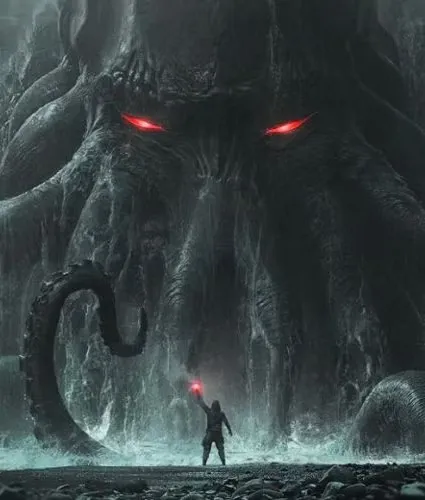
It was the size of a large rat, perhaps a foot long, but it was not a rat. Its body was rodent-like in general outline, but its snout was a mass of small, writhing tentacles — twitching, tasting the air, probing the darkness ahead. Behind the tentacles, rows of translucent, needle-thin teeth were visible, catching the faint moonlight. Its movements were wrong — too fluid, too deliberate, as though it were not walking but flowing across the forest floor.
A second creature emerged. This one carried a knife. Not a metal knife — a blade of white bone, carved and sharpened, held from the top in a tiny clawed hand, ready to strike. The moonlight caught the edge of it.
Mauricio shouted — “Rapido!” — and ran.
He was the fastest, and he had the farthest head start. Trent went next, and it was immediately clear that the boy’s legs were shorter and his lungs smaller and his bladder, tragically, had already given up. Susan grabbed Nari’s hand. The two women ran side by side through the dark forest, branches whipping their faces, roots catching their ankles, the sound of small bodies moving through the underbrush closing in behind them.
Trent stumbled over a fallen trunk and went down hard. He lay in the leaves, gasping, and the creatures were on him in seconds — not attacking, not yet, but circling, their tentacles twitching, their bone knives raised. Susan turned back. She was not going to leave him. She grabbed the boy by the collar and hauled him upright, his wet trousers clinging to his legs, and together they ran.
The creatures were fast. They ran on the ground, they climbed the sugar maples, they leaped from branch to branch overhead. One of them stopped, produced a small blowpipe, and fired a dart that embedded itself in a tree trunk inches from Nari’s head. They were hunting. Coordinated. Intelligent.
Behind them, Clement — who had heard the screaming from his position at the forest’s edge — grabbed a stick and shouted into the darkness, trying to create a perimeter, trying to frighten the things away. They were not frightened. But his voice, and the sound of running feet, and the sheer chaotic noise of four panicked people bursting through the treeline, was enough. The creatures stopped.
Not gradually. Not one by one. All of them, at once, as though a switch had been thrown. They stood in a row at the margin of the forest — fifty small brown shapes in the darkness, their tentacles twitching, their yellow eyes fixed on the investigators. They did not cross into the open ground.
One by one, they turned and dissolved back into the sugar maples. The night was quiet again. Nothing moved in the forest. Nothing sang.
Trent collapsed on the grass outside the farmhouse, gasping. His pants were soaked. His backpack was gone. His book was gone. Mauricio stood over him, furious beyond words.
“You’ve been lying to us all night,” Nari said. “You’re just stupid.”
“Those weren’t familiars,” Susan said. “Do you even know what they are?”
Trent shook his head. “I need to call my mama,” he whispered, and stumbled inside.
The Confessions
The hours that followed were a grim, exhausted accounting.
Father Cloutier found Clement by the farmhouse wall and listened as the Swiss man described what he had seen — the eyes, the creatures, the pursuit. Clement confirmed what the others had already suspected: these were the same eyes he had seen on the first night at the farmhouse, near the tree line. He had dismissed them then as a trick of the light. He would not dismiss them again.
The priest went inside to speak with Trent. He found the boy huddled on the floor, sobbing, reeking of urine and fear.
“Are those demons, Father?”
Trent begged him not to tell Blaine. He was here for extra credit. He couldn’t get in trouble. Father Cloutier took the boy’s hands and told him, with the firm gentleness of a man who had heard ten thousand confessions, that the rituals were over. He was to do his job and nothing more. Trent nodded, shaking.
Clement pulled the priest aside. In the darkness, away from the others, he opened his jacket and showed Father Cloutier something he had carried since the Great War — a service pistol, oiled and loaded. He did not show it to anyone lightly. Father Cloutier understood. Between a man of God and a man who had seen war, there are things that do not need to be explained.
They would retrieve the book in the morning. They would find out what those creatures were. And they would decide what to do about them.
The Dream
Sleep, when it came, was not merciful.
Susan, Nari, and Mauricio dreamed the same dream. Clement, who slept the deep sleep of a man exhausted by digging and terror, was spared. Father Cloutier, whose constitution had been hardened by decades of early mornings and late nights, also escaped. But the three who had stood in the circle — who had heard the creatures squeaking in the dark, who had seen the bone knives — they descended into something worse than nightmare.
It began in absolute darkness. Not the darkness of a room or a forest, but the darkness of the void — a blackness so complete that it had texture, weight, presence. They could not move. Their eyes were open, but there was nothing to see.
Then the buzzing began. A small sound at first, like a fly trapped in a jar. It grew. It swelled. It became a terrible, droning hum, and within the hum, they could hear — or feel — words. Alien syllables that pressed against the inside of their skulls like fingers probing a wound.
A sharp, excruciating pain. Then light — sudden, blinding, fractured.
Images flooded through them, none lasting more than a heartbeat. A forest of twisted oaks, their branches thick with loathsome fungoid growth, the sky barely visible beneath the canopy. A city of sky-blue marble, with slender minarets and high walls lined with bronze statues in medieval garb. A desolate, windswept place dotted with squat granite huts, where unclear humanoid shapes danced and capered around flickering green flames. A vast vista of cylindrical towers in a twilight world illuminated by sickly yellow orbs, with thirty-foot-high doorways and shadows lurking beyond them that made the blood run cold.
The visions faded. They were still paralyzed. But now they seemed to be lying in an overgrown clearing — a place of twisted weeds surrounded by sugar maple trees. It was broad daylight, yet no bird sang. They could sense things moving nearby. Small things. Many of them.
From nowhere, a gut-wrenching woman’s scream.
They woke. On the floor. In the farmhouse. Frightened and confused, with the taste of something sour in their mouths and the buzzing still fading from their ears.
The Morning After
Clement woke with the first light of dawn. He found Father Cloutier already awake, and together they walked into the forest to retrieve Trent’s book.
The clearing was unchanged — the ritual circle still visible in the dirt, the mandrake root lying where Trent had placed it, the milk bottle spilled and empty. On top of the book, a small carcass — bird feathers and bones, picked clean.
Clement picked up the book and studied the ground. Small paw prints. Broken branches. A trail of disturbance leading north through the sugar maples, away from the farmhouse, deeper into the hills. He pointed them out to Father Cloutier.
The priest told him not to follow alone. Clement, who had survived the Alps at night, dehydrated and injured, was not accustomed to being told what to do. But he recognized the wisdom of it. They would return together, later, with provisions and a plan.
At the farmhouse, the expedition was stirring. Blaine emerged from his parlor, bright-eyed and authoritative, announcing that Group A would return to Rice Hill today and he would accompany them — he was eager to see the petroglyph site in person. Clement claimed a cold and asked to stay behind. Father Cloutier offered to remain and tend to the sick — a pretext that satisfied Blaine, who had no reason to suspect that the priest’s interest in staying had nothing to do with medicine.
Nari, too, engineered an absence. She told Blaine she was unwell — a woman’s complaint, delivered with the right mixture of embarrassment and firmness that no male expedition leader would question. Blaine granted it with a wave and a reminder that she would need to make up the work.
Before the groups departed, Clement drew Nari aside and told her about the tracks. North. Leading deeper into the forest. He intended to follow them. Find where the creatures laired. Destroy them.
Nari looked at him with the expression of a woman who had run through a dark forest pursued by things with bone knives. She told him he was crazy. There were fifty of them. They had darts. They had knives. They were intelligent.
Clement was unmoved. He was Swiss. He had been climbing mountains for forty years. He had once found himself in the Alps at night —
She told him to read the book first. Read what Trent had been studying. Understand what they were dealing with before marching off to destroy it. Clement, reluctantly, agreed.
Blaine’s Room
With the house empty, Nari and Clement turned their attention to the parlor — Blaine’s room. The door was locked. The window on the north side was slightly ajar.
Clement climbed through and Nari followed.
The room was spare. A small bed with uncrumpled sheets — Blaine barely slept, or slept elsewhere. A suitcase under the bed. A half-empty bottle of moonshine on the nightstand. Two more bottles in the suitcase. Clothes, few of them.
And a photograph, turned face-down on the nightstand.
Clement picked it up. A portrait of a young woman — attractive, intelligent, with the kind of direct gaze that suggested she was accustomed to being the smartest person in the room. The edges were soft from handling. Someone had held this photograph often, running their thumbs over the corners, pressing it against a palm, sleeping with it beneath a pillow perhaps.
Daphne Devine. The missing student. Blaine’s lost love — or whatever word applied to a man who had obsessed over a woman who did not want him.
There was nothing else. No journal. No letters. No occult texts. Just moonshine and a photograph of a dead girl, kept like a relic.
Nari looked at the image and thought of the way Blaine looked at Clarissa Thurber. Not with love. Not with desire. With possession. The way she looked at her own sketches — something she had made, something she owned, something she did not want to lose.
“He looks at her like she is a tool for his goals,” Nari said.
Clement, who had not been a young man in some time, shifted uncomfortably and suggested they move on.
The Church
While Clement and Nari picked through Blaine’s secrets, Group B — Father Cloutier, Susan, Trent, Laslow, and Noakes — drove into Cobb’s Corners and made for the church.
The First Baptist Church of the Divine Ascension stood on the edge of town, a whitewashed single-room affair with adjoining living quarters. Behind it stretched a large, well-maintained cemetery, the stones white and orderly in the morning light.
Inside, eight rows of pews flanked a central walkway. A raised oak podium held a well-thumbed Bible. Beside it, a large oval plate for donations. The walls were bare. The air smelled of floor polish and something faintly astringent, as though sin itself could be scrubbed away.
The reverend appeared at the sound of their footsteps. Earl Wilson was an imposing man — above average height and build, with powerful shoulders that strained his shirt. His hair was prematurely grey, and a scar ran down his right cheek. His blue eyes were the color of a winter sky — clear, cold, and indifferent to suffering. He spoke with the heavy certainty of a man who had never once doubted that God was on his side.
Father Cloutier introduced himself. Wilson nodded but did not extend his hand. He had been in Cobb’s Corners only a short time — three years, he said. He had not been present when the previous students went missing. The previous reverend, Matthew Hill, had died of a heart attack. Wilson had filled the vacancy.
His theology was simple and terrible. Clean souls. Paradise. Those who did not offer their souls would burn in Hell. He looked at the students with the flat appraisal of a man cataloguing future congregants — or future sinners.
Susan, unwilling to endure more of Wilson’s grim certainties, slipped out to the cemetery. She moved between the stones with the methodical attention of a history student who understood that the dead often told truer stories than the living.
Sarah Maclearan’s grave was easy to find. The stone was weathered but legible. She had died young — consumption, they said. No one had left flowers. No one had visited in years. The earth above her was packed and bare.
But it was the other graves that held Susan’s attention. She counted them. She read the dates. She calculated ages. And the pattern that emerged was the same one Father Cloutier had found in the newspaper clippings the day before — young people dying in Cobb’s Corners, year after year, decade after decade. Disease. Accidents. Falls. Children and teenagers, buried in a churchyard that should have been too small to hold them all but somehow never ran out of space.
No single year was catastrophic. No single cause was epidemic. But the accumulation was damning. In any other town, in any other place, this many young people dying would have been a scandal, an investigation, a Senate inquiry. In Cobb’s Corners, it was just the way things were.
Susan closed her notebook and walked back to the church. Wilson was still preaching. She did not go back inside.
Clement has found a trail leading north into the hills. Nari has a book to read. Mauricio has asked the deputy for a dead boy’s journal. And somewhere in the forest, fifty pairs of yellow eyes are waiting for the dark.