
Protagonists
- Clement Scheidegger - FOC Representative, Mountaineer (Michalis)
- Narinder “Nari” Sodhi - Natural Sciences Student (Ioannis)
- Mauricio Duarte - Geology/Metallurgy Student (Istvan)
- Susan Chen - History Student (Konstantina)
- Father Ludovick Cloutier - Catholic Priest, Religion Lecturer (Tasos)
The Voice from the Stone
“The river, the Gizmond River. It flows south, right? Everybody knows that. Only sometimes, and I’ve watched it many a night from the banks, sometimes it flows the other way — just for a minute, just for a breath — against the current, and then it reverses again and goes on like nothing happened.”
— Old Bill, on a bench by the Civil War memorial
Summary
On the morning of August 17th, Clement and Nari crossed the threshold of the sugar maple forest and followed the creatures’ tracks north. Nari turned back at the sight of a small animal lying in the leaves with its throat opened like an offering; Clement pressed on alone, and in a silent clearing deep in the hills he found a rock with something wrong on top of it — a head that was alive, fused with the stone, begging him to run. What came for him then was the size of a man and shaped like a toad, and by the time the morning was over, Clement was walking home through the trees with a shot head in his pack and the taste of his own unraveling in his mouth. Meanwhile the folklorists gathered the valley’s oldest stories from a drunk on a memorial bench and a sheriff who would not meet his own blood, and the survey team waited out a storm in a truck on Rice Hill until their leader walked away and did not come back. By afternoon the bridge was in the river, something that should not have been alive was floating in the flood, and the man who was supposed to keep them safe had put his hands on Clement’s back and shoved.
- Clement and Nari follow the creatures’ tracks north into the sugar maple forest; Nari turns back after finding a small animal with its throat slit clean and drained of blood.
- Clement, alone, reaches a clearing where a large rock stands beneath a flickering, screen-like image hung in the air — visions of impossible places cycling too fast to hold: a black ship’s galley, a white city wreathed in cloud, a cavern where a sea of bones moves like water.
- Crowned on the rock is the head of a young Black man, fused with the stone and somehow alive — skull cracked open, the brain laced with crystalline threads and a pulsing, luminous fungus, maggots working the cheeks, the tongue hanging slack. It speaks a single word: run.
- A pale, toad-like thing the size of a man, its mouth ringed with quivering tentacles, launches itself at Clement from the clearing’s edge; he drives it back with his service pistol.
- Clement shoots the head. The flickering screen flares, then collapses inward, dragging the wounded thing after it. When the air is still again, only brain matter and a held breath remain.
- In the grip of something beyond grief, Clement pries the head loose from the body embedded in the rock and carries it home in his backpack.
- At the farmhouse, Nari digs into the flower bed and strikes something hard and hollow at the bottom — not timber, not metal — before the rain fills the hole and forces her to cover it over.
- Group B interviews Old Bill at the Civil War memorial: the Gizmond River sometimes runs backward; something long and wrong-shaped lives in it; he once crawled into a riverbank cave with warm walls marked in an unreadable language that collapsed a week later.
- Old Bill speaks kindly of Deputy Cutter — “maybe too kind” — and lets slip that Cutter’s father killed his mother and then himself.
- At the sheriff’s office, Spencer dismisses the Abenaki legends as superstition but repeats, flatly, his grandmother’s old warning: the Green Mountains were not for walking after dark.
- The storm breaks over Rice Hill. Blaine tells the survey team to wait in the truck, walks off to “make a phone call,” and is found hours later dry and locked in his room at the farmhouse.
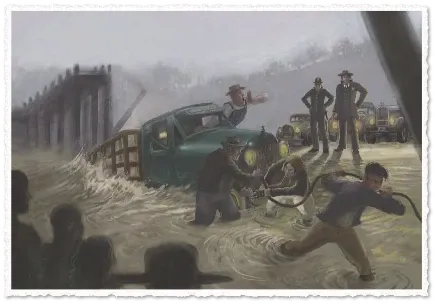
- The Gismend Road Bridge collapses under the returning truck. Harlow and Block are dragged from the river by a human chain of townsfolk.
- A pinkish, tendriled mass with a dark, clawed appendage bobs in the floodwater. As Clement drops to his knees before it, a hand shoves him from behind into the current.
- Back at the farmhouse, Harry Higgins tells them all to be careful around Blaine — and careful when he is not around, too. Outside in the mud, Clement finds footprints that lead not to the outhouse but to the forest’s edge.
The Forest Path
The morning of August 17th came up grey and close, the air already heavy with the promise of the storm that had been building since the day before. While the rest of the expedition split into their accustomed parties — Blaine and the surveyors bound for Rice Hill, Father Cloutier’s folklorists for Cobb’s Corners — Clement and Nari crossed behind the farmhouse and entered the sugar maple forest on foot.
Clement had his Alpenstock and his service pistol and the quiet, methodical certainty of a man who had been walking into bad places for forty years and had always walked out again. As they went he broke branches as he passed, snapping them backward at eye level so the way home would be legible. Nari, her glove pulled over her three-fingered hand, kept close. She did not want to be here. She had run through these trees two nights ago with bone knives whistling past her skull.
They found the ritual circle first, Trent’s circle, the milk bottle still tipped in the dirt. The book was where dawn had left it, with a small bird carcass laid across the cover like an offering — or a warning. Clement slung it into his pack and they pressed on, following the line of small paw prints and broken branches that led north and deeper.
The trees thickened. The light went green and submarine. And then Nari’s boot came down on something soft.
She crouched. A small shape lay curled in the leaf litter, brown-furred, the size of a squirrel. She turned it over with the careful hands of a biologist. Its throat had been opened with a single, clean cut — not the tear of a predator’s teeth but a knife’s work, ceremonial, exact. The body had been drained. There was no blood on the ground, none on the fur. Whatever had done this had taken the blood with it.
The memory of the bone knives came back in a rush. Nari stood. She told Clement, in a voice she struggled to keep level, that she could not go any further. She was not a coward — she had faced a tiger as a child and kept her arm — but she had learned, in the Punjab and in the biology hall both, when an animal meant to warn her away from its territory. These woods belonged to something, and it was telling her to go.
Clement watched her for a moment. Then he nodded. Be mindful of your step, he said. You don’t want to put your foot on another one of those. Nari took her broken branches and her fear and went back the way she had come, and Clement Scheidegger, fifty-two years old, a Luger in his jacket and a rucksack on his back, walked on alone into the green.
The Clearing
The forest went quiet by degrees. First the birds — there were none, and he marked it, and kept walking. Then the small rustlings of the undergrowth, which ceased one by one until only the sound of his own boots on the leaves remained. In the canopy above him, high-pitched squeaks accompanied his progress — not aggressive, not close, but present. He was being observed. He was being escorted.
He sang a little, to keep the silence from settling on his shoulders. A Swiss tune, something to keep the legs moving.
The trees opened. He stepped into a clearing and the squeaking in the canopy rose to a shriek — and then, all at once, fled. The sound of small bodies scrambling away through the leaves rushed outward in every direction, north and east and west, away from this place. The silence that replaced them was absolute.
In the centre of the clearing stood a rock, a metre and a half of dark Vermont granite, its top malformed into something that was not a point. And a few paces from the rock, hanging in the air at the height of a man’s chest, an image flickered.
It had no frame. It had no source. It was simply there — a shimmering, translucent patch of light and colour, no bigger than a window, switching shape as it switched scene. Clement circled it along the treeline, the Alpenstock in both hands. He threw a stone at it. The stone struck with a sound like a fingernail on glass and dropped straight to the earth. He stepped closer and poked it with the iron tip of the staff. The same glassy note. The same resistance. He could not see what was projecting it, because nothing was projecting it. It was simply occurring.
And in the shimmer, pictures moved.
A galley lit by no sun — slaves at their benches, the hull black as a slot of night. A city of white stone, slender and high, half-swallowed in cloud. A green-gold landscape of a kind that did not exist on any map Clement had ever walked. And then a vast cavern, and in it a sea — except that it was not water that moved in waves but bones, thousands upon thousands of them, shifting and toppling against one another in a slow, deliberate surf. The scenes came too quickly to hold. He let them wash past.
Then, from the direction of the rock, a voice.
The Voice from the Stone
He turned.
What he had taken for a malformed cap of stone was a head. A human head, dark-skinned, a young Black man’s, fused into the granite at the neck as though the rock had grown up around it — or the skull had grown down into the rock. It was alive. Maggots worked in and out of the hollows of its cheeks. The jaw hung slack, the tongue blackened and protruding, too swollen to draw back. The top of the cranium was gone, and the brain beneath was exposed — still glistening, still fresh, threaded through with crystalline hairs and covered in a pale fungus that pulsed with its own faint light, in and out, in and out, like a slow heartbeat.
The lips moved. A word came out. It had the wet, thick quality of a voice pushing through a mouth that no longer worked the way mouths should.
Run.
Clement did not run. He stood with his boots planted in the dirt and the image shimmering at his back and he understood, with the sudden and complete clarity of a man who has finally walked far enough, that he had gone past the place where running would help.
He reached for the head. He would take it with him. He would not leave a living man bolted into a stone. He gripped the skull in both hands and pulled, and the head did not move, and a growl rose behind him out of the silent trees.
The Thing in the Clearing
It was the size of a man and roughly the shape of a toad, if a toad had been drawn by someone describing it second-hand, badly. No eyes worth the name. A mass of quivering pink tentacles where the mouth should have been, tasting the air, tasting him. Its body shifted and trembled as though it were not quite solid, not quite decided on its own shape, and when it saw him see it, it coiled and sprang.
Clement fired. The Luger barked once in the silent clearing and the shot went wide; the thing landed in front of him, face to the earth, and rose slowly, the tentacles questing towards him, measuring him the way a butcher measures a carcass. It pressed forward with its whole bulk and a pain like acid seared across his chest where the tentacles touched, and he went down, the back of his skull ringing against the stone.
He fired again from the ground — three shots, fast, the way a soldier fires when there is no time to aim. One struck home. The thing shuddered and drew back. He rolled, Swiss-trained, the barrel-roll of a man who had learned a long time ago in a war-torn valley exactly how to get out from underneath something that wanted to crush him. It leapt to smash him. He was already moving.
And then, on his feet again, the gun hot in his hand, he did the thing he would never be able to fully explain afterwards — not to Father Cloutier, not to himself. He stepped up to the rock, put the muzzle of the Luger against the exposed brain of the head that had begged him to run, and pulled the trigger.
The head died. The shimmering screen flared — faster, brighter — and then folded in on itself like a breath drawn inward. The wounded thing in the clearing scrabbled at the dirt, its tentacles clawing for purchase, and the image took it. It was dragged across the earth as if by an undertow, clawing, and then it was gone, and the shimmer was gone, and the clearing was only a clearing, with brain matter on a rock and a Swiss man standing over it with a smoking pistol and nothing left to shoot at.
What Clement Carried Home
Something in him came loose then. He would not have used the word madness — he was Swiss, and precise, and had survived the war and the mountains and forty years of his own company — but for some long minutes afterwards he was not entirely himself. He went to the rock. He worked the Alpenstock down between the skull and the granite, wedging, levering, ignoring the small wet cracks the sound of which he would later choose not to remember. The head came free with a suck of released tissue. The body remained in the rock — a dark circle of spine and shoulder-blade, embedded, growing out of the stone the way a fossil grows out of a cliff face.
He wrapped the head in a cloth and put it in his pack. He owed the man that much. He was sorry about the bullet. The creature would have done worse.
By the time the treeline closed behind him and the farmhouse showed itself through the last of the maples, he had recovered enough to know that he could not tell the students any of this, and not recovered enough to know that walking home with a dead man’s head in his rucksack was not, by most measures, a sane act. Nari was in the flower bed with a hammer. He told her he had tripped. He was covered in blood and burns and the grey dust of the trail. She did not believe him. She did not press.
The Flower Bed
While Clement was in the hills, Nari had gone to ground at the back of the farmhouse with the patience of a woman raised among botanists.
The flower bed was the size of a grave. She had established that already. Now she knelt at one corner and worked with a small hammer and a ladle from the kitchen, prying out the soil in careful spadefuls, lifting each plant — lilac, daisy, buttercup — with its roots more or less intact and laying it aside on a cloth. The earth here was soft. It wanted to be dug. Someone had been turning it, secretly, for years.
She dug for the better part of two hours, slow and careful, and at the bottom of the hole — forty centimeters down — her hammer struck something that was not earth.
It gave back a hollow note. Not the dull thud of timber. Not the ring of metal. Something between ceramic and stone, like the wall of a vessel, or the lid of a sarcophagus sized down to a woman’s proportions. The rain chose that moment to arrive in earnest, and within minutes the hole she had opened was a muddy pool, the thing beneath it hidden again under brown water. She replaced the flowers as best she could, raked the earth flat over the wound, and told no one outside the circle. But she knew now, the way Susan had known the day before. The flower bed was a grave. Whatever lay in it had been put there in something hollow, and tended ever after by hands that came in secret and in love, or in something that wore the same shape.
Old Bill
In town, the folklorists had gone looking for the last of the named sources.
They found him asleep under a bench at the Civil War memorial, a folded newspaper tented over his face, a fishing rod of heroic disrepair propped against the slats beside him. Old Bill was a ruin of a man — long white hair, long white beard, the hair around his mouth stained the colour of urine and tobacco from decades of both. The students brought cigarettes, which was the only currency he recognised, and he sat up on the bench and smoked half of one in a single draw and asked them what they wanted.
He told them about the river. The Gismend flows south — everybody knows that. But Bill had watched it from the banks on many a moonlit night, and sometimes, for a minute, for a breath, it ran the other way. Against the current. And then reversed, and went on as though nothing had happened. Now you are the educated ones, he said, ashing the cigarette on his knee. Tell me what makes a river run backwards.
And the fish. He had fished the Gizmond every day of his life. He knew every species in it. But there was something else in the water — long, thin, the wrong shape, its shadow moving against the current on moonlit nights. Not a fish. Not an eel. Not anything he had a name for.
And the caves. Along the riverbank, small black openings in the rock, most too tight for a man to enter. Ten years back, a flood had torn one open wide enough to walk into. He had taken a lantern and gone thirty feet before the passage turned and began to climb, not into the hill but under it. The walls were warm to the touch. And marked — not carved, not natural, something between, regular as writing, in a language he hoped to God no one on earth could read. He had left. A week later the cave had collapsed. Natural, they would say. Sure. Natural.
He did not believe in Sarah’s ghost. He had slept outdoors his whole life and never been troubled. Asked about Broken Hill, he waved the question away — no river there, no point. Asked about the Abenaki, he said they had left the valley, and they were wiser for it. This place is cursed, he said. The young ones die. The students disappear. He looked at Susan. Go back where you came from.
Only when they asked about Deputy Cutter did his voice change. A kind fellow, Old Bill said. Maybe too kind. He had known the parents. They had died some years back — a tragedy. The father had cut the mother’s throat and then his own.
He said all of this with the evenness of a man who had stopped expecting the world to surprise him, and then he stood, because the first drops were starting to fall, and he shambled away under his newspaper without looking back.
The Sheriff
The rain was beginning in earnest when they reached the sheriff’s office — a single story of thick brick, barred windows, institutional green paint. Inside, two desks, filing cabinets, a locked gun cabinet, and three empty cells. Sheriff Dan Spencer sat behind one of the desks and looked up as they entered and spoke before they could.
What’s wrong?
They asked for an interview. Spencer was not eager. He wore a cross at his throat and the distant, practiced patience of a man who had been asked about his grandmother’s people once too often. The Abenaki blood on his mother’s side, he said, didn’t change who he was or what he did. His mother had raised him Christian. The Abenaki had been peaceful. They had left because the farming was poor, not because of spirits, and anyone who said otherwise was repeating gossip.
But when they pressed — about Broken Hill, about why his grandmother’s people had really come down out of the mountains — his voice went flat. The Green Mountains weren’t for walking after dark. That’s what she told me. I try to keep that promise.
He denied knowing anything of underground tunnels. He denied knowing anything at all. Susan used the excuse of the bathroom to walk the building’s single corridor. There was no evidence room. There was nothing here but paperwork and a gun cabinet and the smell of disinfectant failing to do its work.
On the way out, Spencer looked at Trent, who was trembling, and mentioned — almost brightly — that he hoped none of the students was consuming alcohol. It was the closest thing to warmth he had shown all morning, and it landed like a warning.
The Storm
By early afternoon the sky over the Green Mountains had closed like a fist.
The rain came down in sheets. At Rice Hill, the survey team huddled in the truck bed under a tarp and watched the water turn the ruts of the access road into a chain of brown ponds. Mauricio dug through the morning and turned up more of what the hill always gave — arrowheads, a bone ring, the corroded point of a hunting spear, no pasquallium, never any pasquallium — and tried, once, to tell Blaine about the things he had seen in the forest the night before.
Blaine laughed it off. Did you drink too much of that moonshine I gave you? he said. It’s strong, isn’t it. And he wandered back to the petroglyph and ran his fingers over it and said nothing more.
When the rain began in earnest, Blaine stood up from the dig and announced, to no one in particular, that he had seen this weather before and it would pass. They should wait it out in the truck. He would walk down to the Williamson farm and telephone the farmhouse, make sure the other group was safe. He would be right back.
He walked south into the grey wall of the storm and did not come back.
They waited an hour. They waited two. Mauricio asked Joe Harlow — who had stayed, as he always stayed, rolling cigarettes and watching the sky — to take them home. Harlow said the road was turning to soup, the truck would never make it. They ate cold beans from a can and watched the rain.
At the farmhouse, the door opened around four in the afternoon, and Blaine walked in wet and composed, and found Clement and Nari waiting for him.
The Man Who Came Back Alone
You sound much better, Mr. Scheidegger, Blaine said, in the tone of a man who has prepared his entrance. He had left the survey team in the storm, he explained. He had come back to call the sheriff, in case something happened. Bad things happened on those mountains sometimes.
Nari stared at him. You abandoned the others and came back here to call the sheriff.
In case anything bad happens, Blaine said, and did not blink, and held her gaze, and then walked into his room and locked the door behind him.
They stood in the front room and listened to the lock turn. Clement, who had carried a head home in his pack that morning and was in no mood to be lied to, put his shoulder to the conversation. Where are the others? What happened to Mauricio? What happened to Clarissa?
From behind the door: Please. I’m trying to sleep.
It was the sheriff’s siren, eventually, that pulled them out of the house — the sound of it rising somewhere north of town, toward the bridge. Clement took one look at Nari and told her to stay, to lock the door, to let no one in. Blaine came out of his room, suddenly helpful, suddenly wide awake, and the two of them set off down the road toward the river, the rain coming down in ropes around them.
The Bridge
The Gismend Road Bridge was gone.
The river had risen in the night and undermined the pilings, and the centre span had dropped away while the truck was crossing it. The Ford AA had swung out, spun, and gone into the water nose-first, lodging itself on a hidden sandbank with the cab half-submerged and the students in the bed scrambling up onto the roof like rats off a sinking crate.
Mauricio could not swim. He had neglected to mention this to anyone until the river was in the cab with him. He dragged himself out through the window and onto the roof of the truck and from there onto the bonnet, shaking, the water boiling brown around his ankles. Beside him, Joe Harlow — who also could not swim, who had driven these roads his whole life and never once been asked to swim — lost his footing on the bonnet and went into the current with a small, ashamed cry.
Roderick Block went in after him. The big football player hit the water like a stone and came up with Harlow by the collar and fought the current with one arm and the old man with the other, and for a long moment the river had them both. On the near bank, Sheriff Spencer was running a rope out. Deputy Cutter was there. Louis Gibbons and Harry Higgins were there. They formed a chain and dragged the two of them, blue and coughing, up onto the mud.
The river, having given up its living, offered up its dead.
The Thing in the Water
It came floating past the wreck of the bridge in the brown water — a mass the colour of raw meat, pinkish and glistening, tendrils trailing from it and a single dark appendage, clawed, red, rising above the surface like the arm of a drowning man reaching for the bank.
The students on the near shore pointed at it. What is that. What is that. Mauricio, who had survived the night, saw it and understood with the calm, detached part of his mind that he was looking at something that was not debris, and was not an animal, and was not meant to be in any river in Vermont. The water carried it past. It did not move on its own.
On the far bank, Clement and Blaine arrived just in time to see it.
Clement had already seen a head speak to him that morning. He had already shot it. He was carrying it in his pack. Something in the scaffolding that held him upright gave way, and he dropped to one knee in the mud, the Alpenstock taking his weight, his free hand over his face, and for a moment he was not a man of fifty-two who had crossed the Alps but something smaller, something the valley was trying to digest.
A hand settled between his shoulder blades — light, almost companionable — and pushed.
He went into the river with a shout and the cold closed over his head. He came up choking, the current taking him, and on the far shore Mauricio was already running with a rope, screaming his name, and someone — it was not clear who — threw a coil out into the current, and Clement caught it, and they hauled him hand over hand up onto the mud beside Block and Harlow, shivering, the contents of his pack soaked through.
On the far bank, Blaine was shouting, There is a guy in the river! Save that guy! Help him! as though he had not been standing next to him a moment before. The pink mass drifted on downriver, and the attention of the crowd went with it, and then drifted further, and was gone, and no one spoke of it again for the rest of the afternoon.
The Head and the Priest
It was dark by the time the last of them was dragged home. They came back by the long way, the bridge being gone, and filed into the Maclearan farmhouse dripping, beaten, quiet. Nari had hot water ready. Clarissa was wrapped in blankets. Harlow sat by the fire in someone else’s coat and did not speak.
Clement took Father Cloutier aside, into a back room, and closed the door, and told the priest that he had something to show him, and that it was not pleasant, and that he was sorry.
He unwrapped the cloth.
The priest was a man who had knelt at ten thousand deathbeds and who understood, as part of his office, that the world contained more than the catechism accounted for. He looked at the head — the opened skull, the luminous fungus still faintly pulsing in the dark of the room, the slack jaw, the mouth that had spoken — and he crossed himself, and he did not look away, and he did not ask Clement whether he was sure. He knew Clement was sure. A Swiss man with a Luger does not bring home a thing like this on a whim.
Clement told him about the clearing, the shimmering screen, the toad-thing that had come for him. And then, quietly, the thing he had not told Nari: that when he knelt at the riverbank, a hand had pushed him in, and the hand had been Blaine’s.
What Higgins Said
They did not have long to sit with any of it. Sometime after dark, Blaine announced he was going to the outhouse and stepped out into the rain.
He was gone a long time.
Harry Higgins, still damp, his hair plastered to his forehead, looked around the room at the students who would meet his eye. He was done being polite.
He was supposed to be the chief, Higgins said. He left us out in a monsoon. Before he left, he said to wait for him, he’d be right back. Now we find out he was dry in here the whole time. Did he ever mention that we were waiting back at the truck?
No one answered.
Look at the university’s last foray out here, Higgins went on. One person dead. Two still missing. One of them his girl. And he was laid up with a broken arm and couldn’t go with them that day. He let it land. Pretty lucky, on his part.
He looked around the room again.
I’m not saying we go home. This is a great opportunity. What I’m saying is — be careful around this guy. In fact, be careful when he’s not around, too. I’ve got a bad feeling about him.
The room was very still. Susan and Nari exchanged a glance. Father Cloutier, in the doorway to the back room, said nothing, but his hand found the rosary in his pocket.
Clement stood up, took the expedition camera, and went out into the dark.
The rain had eased to a drizzle. He walked around the side of the house to the outhouse. The door was open. The seat was dry. And in the mud outside, two sets of prints: Blaine’s boots, heading out — and not stopping at the outhouse, but turning toward the tree line, where, a few yards in, they were joined by a second set of prints, longer and narrower and wrong in a way he could not name, the kind of track no boot and no paw would make. The rain was already filling them in.
He went back inside.
The Lie
Blaine came back ten minutes later, straightening his belt, and found a room that had stopped pretending.
Where were you? Nari said. The outhouse was empty.
Who said that? You were just there.
In the outhouse, of course. Blaine looked at Clement, then at Nari, then at the priest. Is there a problem?
Clement said, very evenly, that he had checked.
Blaine smiled. He produced a bottle from inside his coat — moonshine, from his private store — and held it up. Drink night, everybody. Mr. Clement, do you like alcohol? Nobody moved. He poured for himself.
Nari stood. You left us there. You left them there in the field. You only called the sheriff when we knocked your door down. You are a liar. You are a coward. Tomorrow I am calling my father, and the leadership of the university will know all of it.
Blaine raised the glass to her, and to the room, and drank.
Outside, the rain picked up again. The tracks in the mud were gone. And in a bag in the back room, in the dark, something that had been a man lay with a bullet hole through what was left of its mind, and the fungus that had lit it was going slowly out.
Next: The flower bed gives up its secret. The sheriff comes to the farmhouse with questions of his own. And somewhere above Cobb’s Corners, the things that Blaine went to meet in the rain are done waiting.