
Protagonists
- Clement Scheidegger - FOC Representative, Mountaineer (Michalis)
- Narinder “Nari” Sodhi - Natural Sciences Student (Ioannis)
- Mauricio Duarte - Geology/Metallurgy Student (Istvan)
- Susan Chen - History Student (Konstantina)
- Father Ludovick Cloutier - Catholic Priest, Religion Lecturer (Tasos)
The Bones the Rain Brought Up
“The only things living in this valley are men and the things men brings.”
— Agnus Bellwether, midwife, in her failing house near Broken Hill
Summary
On the morning of August 18th, Clarissa Thurber’s scream brought them all out of the farmhouse in their bedclothes. The overnight flood had receded, and the flower bed — Nari’s flower bed, the impossibly tended riot of violets and daisies behind the outhouse — had given up what it had been hiding. Bones. Human bones, washed up out of the earth, a skull still half-buried in the mud. Sheriff Spencer came, and knelt, and said nothing for a long time, because he knew already whose bones they were. By the end of the day the expedition had split in two: half of them up on Broken Hill, where the birds do not sing and an entire people lies heaped in a single pit at the foot of the slope; half of them in Cobb’s Corners, where a doctor who believes in vampires described the town’s dead children, and a schoolteacher showed a priest the drawings her pupils make over and over — a dark shape, like a tree but not a tree, with little figures gathered at its base. And through it all, Robert Blaine moved among them, smiling, watching Clarissa Thurber.
- Clarissa’s scream draws the house outside at dawn: the flood has washed human bones to the surface of the flower bed, a skull still lodged in the earth.
- Nari, reaching into the muck, cuts his finger on a fragment of bone; the wound bleeds and will need seeing to.
- Father Cloutier telephones Sheriff Spencer, who arrives and kneels a long time over the bones before confirming, quietly, that they are Sarah Maclearan’s — his own sister — reburied in secret by her husband.
- At the sheriff’s office, overheard by the folklorists, Spencer locks Jimmy Maclearan in a cell, calling him a drunkard who has embarrassed the whole town; Jimmy buried Sarah under her favourite flowers because her grave would not stay left alone.
- Dr. Owen Perry, an eccentric who fancies himself a vampire hunter, collects the bones and describes a long pattern of local children found drained, with pig’s blood in their veins — and of town children who smile at their friends’ funerals.
- Nari telephones her father in Arkham to report Blaine’s drinking and recklessness; Professor Sodhi promises to contact Professor Harrold and send help.
- The expedition splits: Clement, Mauricio, Nari, Clarissa, and Block head to Broken Hill with Joe Harlow; Father Cloutier and Susan remain in Cobb’s Corners.
- Broken Hill is wrapped in an absolute silence — no birds, no insects, no wind in the scrub — the kind of quiet that presses against the ears.
- Out of Joe Harlow’s sight, behind a rock, Clement unwraps the head and shows Nari and Mauricio the opened skull, the crystalline threads laced through the dead brain, the luminous fungus going dark.
- The dig uncovers beads, arrowheads, worked silver — and then a mass grave: men, women, children, dogs, all thrown together, all buried at once in a single desperate pit.
- Blaine visits the site, stands close to Clarissa, presses a bottle of moonshine on Mauricio, then drives off in the only working car.
- Dottie Phelps tells Father Clouter of children cutting open a live cat behind the schoolhouse while the others stood in a circle and sang in a language no one knew.
- The schoolteacher Holly Rydal shows the drawings her pupils produce, over and over — a dark tree-like shape with little figures at its base — and admits she is afraid of her own students.
- Susan, searching the Gazette’s back issues, finds that Deputy Cutter’s father murdered his mother (carving a strange symbol into her chest) before killing himself, and that the aunt who raised him later swallowed acid.
- Susan attempts to enter Cutter’s empty house but is spotted by a neighbour and retreats.
- Agnus Bellwether, the valley’s aged midwife, tells of the original tribe wiped out in a single night and buried at the foot of a hill — and of falling stars that do not always fall from the sky.
- Fog begins to form on Broken Hill as the sun sets, and the stranded survey team settles in for the night beside a fire they did not ask for.
The Screaming at the Flower Bed
There were no dreams that night. Nari noticed it first, in the grey hour before waking, and Susan and Mauricio marked it too in their own ways — the buzzing silence, the absence of the thing that had been pressing against the inside of their skulls for two nights running. Something had changed in the forest. Something had stopped. But there was no time to compare notes, because the scream came.
It was Clarissa. It came from outside, from the direction of the flower bed, and it was the kind of sound that lifts a whole house out of its sleep. Clement was on his feet with the climbing hammer before he was properly conscious. Nari was already at the window. Through the glass she could see Clarissa standing between the outhouse and the flowers, stock-still, her nightdress pale against the mud, staring down at the bed.
The night’s flood had done what Nari’s hammer had started. The water had risen through the disturbed earth, and when it withdrew it had taken the soil with it. Bones lay scattered across the surface of the flower bed — long bones, ribs, the curve of a shoulder blade — pale and clean and wrong against the trampled violets.
Clement and Nari reached her first. Clarissa was not hurt, only shaking, her hands over her mouth. Behind them the rest of the household was stumbling out in various states of undress, and there was Blaine, emerging from the parlor where Father Cloutier had exiled him, wide-eyed and asking what was the matter in a voice that carried precisely the right amount of surprise.
Mauricio, whose morning had not yet included breakfast, crouched at the edge of the bed and reached into the muck to pick up one of the longer fragments. The bone gave under his fingers like wet chalk and a jagged edge laid his index open to the knuckle. He hissed and pulled the hand to his mouth. The blood came freely. Susan had bandages upstairs. Clarissa would not stop staring at the white shapes in the dirt.
They dug. There was nothing else to do. Beneath the scattered bones they found the skull, still seated in the earth as though it had never moved, and beside it a spine that curved the wrong way — not the spine of a healthy person, Father Cloutier noted grimly when he knelt beside them. The bones were human. Adult. Beyond that, none of them could say.
Someone would have to call the sheriff.
The Sheriff’s Sister
Father Cloutier made the call from the telephone in the front room, and within the hour the sheriff’s car came grinding up the rutted track. Dan Spencer climbed out alone, his heavy face set, and walked to the flower bed without speaking. He stood over the bones for a long time. Then he knelt, and his hand went to the cross at his throat, and he said, very quietly, that he would need to telephone Dr. Perry.
He knew whose bones they were.
The connection — the thing the students had been circling for days without naming — was simpler and sadder than any of them had guessed. Sarah Maclearan had been Spencer’s sister. Her body had been stolen from the cemetery years ago, the coffin found to contain a dead calf, and her husband Jimmy had taken her and reburied her here, behind the house where they had lived, under the flowers she had loved. He had tended the bed for years. In secret. Because the grave would not stay shut, and this was the only thing he could still do for her.
When Father Cloutier and Susan reached the sheriff’s office later that morning, they heard the rest of it through the door before they entered. Spencer’s voice, low and ragged: Jimmy, you’re an idiot. Why did you bury Sarah at the house? And Jimmy’s voice, smaller, maudlin: I wanted her to be next to her home. Under her favourite flowers. A pause. You’re very lucky I’m your brother-in-law. I will not report what you did. But you have embarrassed everybody in Cobb’s Corners. The cell door closed. Spencer told them, as they stepped in, that Jimmy would spend a couple of nights sobering up.
The Doctor Who Believes in Vampires
Dr. Owen Perry arrived in his Chevrolet around mid-morning — a round, jovial man of about sixty, with snow-white tufts above his ears and bright blue eyes that moved too quickly for his comfortable face. He wore a cross on his coat and he looked, as he crossed the yard to the flower bed, like a man stepping into a room where he expected to find something waiting for him.
He knelt over the bones with a farrier’s sack and collected them, bone by bone, with the unhurried care of someone who had done this before. He confirmed what Spencer already knew. Sarah. He would see to the reverend about a proper burial.
Then he sat down in the farmhouse kitchen, and because Father Cloutier wore a cross too, he began to talk.
He had come to Cobb’s Corners twelve years ago to semi-retire, he said. A quiet town. A pretty valley. He had not been here a month before the strange cases started. Children — local children, farm children, children of God-fearing families — found dead in places and in ways that did not bear examination. A boy who fell down a well in a quarry, though he had been terrified of heights. A girl who fell onto a pitchfork in her father’s barn, three prongs clean through. And in every case, Dr. Perry said, leaning forward, the blood was wrong. He had tested what little remained in their veins. It was pig’s blood. Not kosher at all, young lady, is it.
Father Cloutier asked, gently, whether he had ever seen the bites.
He had not. But he had read about them. He had seen the picture shows — Nosferatu, have you seen it? — and he knew what he was looking at. There was a vampire in Cobb’s Corners. He was sure of it. He had been sure for years.
And then, almost as an afterthought, the thing that stayed with Susan longer than the rest: the children at the funerals. They just smile, he said. Their friend dies, and they only smile. Can you imagine that? He could not explain it. He did not seem to want to. He picked up his sack of bones, crossed himself, and left.
The Daughter’s Call
While the doctor talked, Nari was at the telephone.
She had threatened it the night before, and now, with the house in an uproar and Blaine hovering in the yard watching Clarissa’s face for grief, she went through with it. She dialled the long-distance exchange and asked for the natural sciences department at Miskatonic, and after a series of clicks and pauses her father’s voice came on the line, alarmed and far away.
She told him. The drinking — the moonshine that Blaine passed around and drank himself. The expedition left out in the storm on Rice Hill while Blaine came back to the farmhouse dry and locked his door. The bridge going down, the river, the near-drowning of half the team. The bones in the flower bed. The animals in the forest that had come at them. The young man, Trent. She did not tell him about the head. She did not know how to begin. She said instead that she thought she might be hallucinating, and heard her own voice saying it, and knew how it sounded.
Her father listened. He asked whether anyone had touched her. He asked for names. Blaine, she said. Robert Blaine. The leader. There was a long silence on the line. Then Professor Sodhi told her, in the steady measured tone of a man who was already making plans, that he would telephone Professor Harrold himself and that help would come. Until then, she was to be safe, and stay near her friends, and trust the priest.
He said Hare Krishna and hung up. Nari looked at the telephone for a long moment after the line went dead. Then she folded the notes she had written for her father and for Father Cloutier — directions to the farmhouse, an explanation, a map — and left them beside the instrument in case the help her father sent arrived when she was not there to meet it.
She did not tell Blaine what she had done.
The Hill Without Birds
It was Clement who settled the question of the day’s work. The digging team would go to Broken Hill — the place Blaine had been keeping them away from all week, the place where last year’s expedition had vanished, the place where Victor Pasqualle had found his impossible mineral. He proposed mixing the groups. Blaine, cornered by the request and the eye of the room, could not refuse without showing his hand. Clement would take Mauricio, Nari, Clarissa, and Block; Father Cloutier and Susan would stay in town and continue the interviews. Blaine, for the first time, would not ride with either party. He had business, he said. He would come and check on them later.
Joe Harlow had the truck running by seven, his face grey with exhaustion — he had been underneath it since before dawn, cleaning out the flood damage. He loaded their gear: tents, bedrolls, tins of beans, the digging tools, the documentation kit. He sniffed the air, pronounced the day clear by the dryness in his nose, and put the truck in gear.
The road to Broken Hill ran east and then south, around the destroyed bridge, through country that opened up into long stony pastures fenced with split rails. The hill announced itself before they reached it: a bare rounded summit rising out of the treeline, pale as a scraped bone, with a few scraggly pines on the upper slopes and nothing else.
They felt it before they put a name to it. Mauricio, climbing out of the truck bed at the camp site, said it first: there were no birds. No sparrows in the scrub, no jays in the pines, no crows on the summit. The deer, Nari remembered, came down every slope in the valley except this one. Ed Tanner’s chickens would not look toward it. Even the insects were absent. The silence was not the comfortable quiet of a high meadow. It pressed against the ears. It had weight.
Clement, who had stood on peaks in four countries and slept in the open above the snow line, said that not even the Alps were this still. At altitude you heard something — the creak of a glacier, the cry of a bird, the wind in the stone. Here there was nothing. Only the breeze, when it came, and even that sounded reluctant.
Joe Harlow unloaded the last of the gear and would not look at the summit. This was the place, he said, almost to himself, where he had dropped Daphne Devine and Patterson and Jeffrey a year ago. Their camp had been found two days later, intact, uneaten, abandoned. The search dogs had sat down at the foot of the hill and refused to go further.
Behind the Rock
While the others began to set the tents, Clement caught Nari’s eye and nodded toward a boulder at the edge of the camp, out of Joe Harlow’s line of sight. Mauricio followed. When they were screened from the camp, Clement knelt and unslung his pack and drew out the cloth-wrapped bundle he had carried down from the forest two days before.
He had not told them. Father Cloutier knew. Now it was their turn.
The cloth fell open. Nari made a sound — a short, involuntary thing, bitten off at once.
It was the head of a young man. The skull had been opened, the cranium removed, and the brain inside was threaded through with fine crystalline filaments — hair-thin, glassy, catching the light — and covered in a pale fungus that had pulsed with its own faint luminescence when Clement had found it. Now the fungus was dark. The thing was dead, or going dead, the tissue beginning to soften and sink in on itself. But the shape of what had been done was unmistakable. Someone — something — had opened this man’s head and put things inside it that did not belong in any anatomy Mauricio had studied.
Clement told them, in the flat even voice he used for facts he did not enjoy, where he had found it. The clearing. The rock. The image that had hung in the air. He did not dwell on the thing that had come for him. He told them about the voice, the single word — run — and about the bullet he had put through the brain because the creature would have done worse.
Mauricio, after a long silence, asked whether they might find pasquallium on the summit, and whether the mineral might have something to do with what had been done to the head. The two ideas connected in him somewhere — the strange superconductive ore and the crystalline threads — and he wanted to carry the head up the mountain when they climbed, to test it. Clement, who had been carrying it for two days and was not entirely sure why, agreed.
Nari wanted to sketch it. She knelt and opened her book and her hand was steady, which surprised her. She had screamed. Now, with the morning light on the dead fungus and the silence of the hill pressing around them, she found she could look. She had seen worse in the forest, behind Trent, the night the animals came.
They wrapped the head again, hid it in Clement’s pack, and went back to the camp before Joe Harlow came looking.
The People in the Pit
They dug.
Blaine’s map marked the burial mound at the foot of the hill — the same mound Daphne Devine had identified the year before, the reason she had come back. It was the reason all of them had come back, though only Blaine knew that for certain. Clement laid out a grid. The students took their stations. The work was slow and methodical, the way Professor Learmonth’s department had taught them: trowel, brush, record, bag.
The first finds were ordinary, or ordinary enough — quartz arrowheads, beads of shell and glass, small bent pieces of silver that had once been jewellery, porcupine quills worked into patterns, bone awls. Nari sketched each one in her book. Mauricio catalogued. The sun climbed. The silence held.
Then the bones began.
They came up in clusters, not laid out but tumbled, the long bones and the ribs and the small delicate finger-bones all mixed together with no order and no ceremony. And among them, dog skeletons — three, four, more — heaped in with the people. Nari knelt in the trench and brushed the dirt from a pelvis and a child’s skull lying against it and understood, with the slow cold certainty of a woman raised among biologists, what she was looking at.
This was not a burial ground. This was a single pit. An entire community — men, women, children, elders — had been buried here, all at once, with all their possessions and all their dogs, in one grief-stricken act. They had not been arranged. They had been placed in the earth and covered over, quickly, by the survivors of whatever had happened. The bones were fractured in places, but not in the pattern of a battle. Something had killed them all at once, or near enough, and the few who remained had buried their dead in the only way they could.
Nari thought of what Old Bill had said, and what the Abenaki legends said, and what the silence of the hill said, and she did not say any of it aloud. She kept her sketchbook open and her hand moving. There would be time to be afraid later. There was work to do.
The Gift
Blaine arrived in the early afternoon, driving the second car alone. He parked at the foot of the hill and walked among them with his hands on his hips, asking after the work, full of professional encouragement. Professor Learmonth will be very happy. Record everything. Make everybody record everything. He stood close to Clarissa Thurber — closer than he needed to, his hand finding her elbow, his voice dropping to the warm private register he kept for her. Do you need anything? Are you all right? Clarissa, who had screamed at a flower bed that morning, said she was fine and stepped away.
He asked after the dig, and Mauricio told him about the mass grave, and Blaine nodded as though this were exactly what he had expected. This was where Pasqualle had found the pasquallium, and that Pasqualle’s last telegram had placed the discovery somewhere in the vicinity of Broken Hill, without naming the precise spot. Blaine produced a bottle of moonshine from his coat and pressed it into Mauricio’s hands — for the cold night, for the nerves, a gesture of goodwill from the expedition leader to his hardworking team.
He told them he would leave the truck with them. He would take the car back to the farmhouse, check on the other group, and return in the morning. He suggested, lightly, that a night under the stars would do them all good. Fresh air. Clear heads. He patted Mauricio’s shoulder, nodded to Clement, let his gaze rest on Clarissa for a beat too long, and got back in the car.
They watched him go. The sound of the engine faded down the track. Joe Harlow, who had been lingering by the truck, lit a cigarette and said nothing.
The Cat Behind the Schoolhouse
In town, Father Cloutier and Susan had been busy.
Their first call of the day was on Dottie Phelps, a tall, red-headed farm woman of twenty-eight who had been in the valley two years and had, in that time, assembled a theory. She ushered them into her kitchen and spoke low and fast, as though the walls had ears. Everything here is smoke, she said. Ghosts, vampires, the devil — that’s what they’ll tell you, and it’s all cover. The real story is the children. Something is wrong with the children of Cobb’s Corners.
She helped out at the school sometimes, she said. The teacher, Holly Rydal — a lovely woman, a nervous woman — had sworn her to secrecy and then told her what she had found behind the schoolhouse one afternoon. A group of children. A live cat, cut open. The rest of the pupils standing in a ring around them, singing. The words were in no language Holly recognised. When she had confronted them, a boy of ten — no more than ten — had looked her in the eye and told her he would kill her if she spoke of it. And she believed him, Dottie said. I’ve seen the kids since. There is nothing behind their eyes.
And the drawings. Holly had shown her the drawings. Most of the children drew what children draw everywhere — houses, horses, trees. But a few of them, over and over, the same composition every time: a great dark shape, like a tree but not a tree, with things hanging from it and little figures standing at the base. Always the same. Kids that age don’t draw the same thing that consistently unless they’ve seen it, or unless someone told them exactly what to draw.
When one of the children died — in an accident, always in an accident, always somehow alone — the rest did not grieve. They looked satisfied. Like a job well done.
Father Cloutier went directly to the school.
It was a one-room building, painted red, with a bell out front. Holly Rydal met him at the door — a young woman with auburn shoulder-length hair, wide eyes, a flowery dress down to her ankles, and the distracted, frayed air of someone who had not slept well in a long time. She did not want to talk at first. A small boy came to the door during their conversation and asked her a question, and the look that passed between the teacher and the child told Father Cloutier more than any confession could.
She confirmed it. The high death rate among her pupils — she had taught at two larger schools before returning to care for her ailing mother, and she had never seen anything like it. One pupil dead last year. Two already this year. And Mrs. Hunter, the previous teacher, dead two years back under circumstances no one discussed: a fall down stairs in the dark, with a kitchen knife in her hand, five wounds in her back.
And the drawings. She showed them to him, reluctantly, and there it was — the dark shape with the hanging things and the little figures at the base, rendered in a child’s crayon with the obsessive precision of something seen and not imagined. On the back of one, in a careful hand, a rhyme:
They have watched us for so long. Where we are little, our brothers are strong. Yes, mother loves me, yes, mother loves me, yes, mother loves me. For the others tell me so.
Father Cloutier, who had knelt at a thousand altars and heard a thousand confessions worse than any priest should carry, looked at the rhyme and said nothing for a moment. Then he asked the teacher’s permission to return that afternoon and hold a blessing — a Holy Communion, he called it, harmless, the sort of thing the church did in country schools everywhere. For those who came, he had a bag of sweets. Chocolate. Candy. The things children could not resist.
Holly Rydal looked at him as though he had proposed to walk into a bear’s den with a picnic. She could not stop him. She did not believe it would help. But she told him to speak to the reverend, and to come back before the children went home for the day.
The Cutter Blood
While the priest was at the school, Susan was at the Cobb’s Corners Gazette.
Richard Wendell, the editor, was behind his desk and grateful for company. She had a scoop for him — the bones at the farmhouse, the sheriff’s brother-in-law — and in exchange she asked for the back issues. She wanted the Cutter family.
What she found, in the yellowed pages of the local paper, was this. Fifteen years ago, Robert Cutter — Deputy Cutter’s father — was found dead in his home beside the body of his wife Elizabeth. At first the paper had reported a double suicide. The coroner’s examination changed that. There had been a great deal of blood on Robert’s hands. He had killed his wife first. And on Elizabeth’s chest, carved with a knife, was a strange symbol — described in the article, but not illustrated, not named, only strange, only weird. Then Robert had taken his own life.
The boy — Deputy Cutter — had been five years old. He had gone to live with his aunt.
Susan turned the pages forward. Eight years ago: another death. The aunt. She had swallowed acid. The paper called it suicide. The boy, by then a young man, had been left alone.
Wendell showed her the house on the map — a small white-painted place, one floor and an attic, unremarkable, on a quiet street. Susan thanked him, asked him to keep their conversation between them, and went to look at it.
The house was empty. Cutter was at the sheriff’s office. She walked the perimeter, checking the sightlines from the neighbouring fences, and was about to try the back door when a man on the other side of the fence looked up from his sunflower seeds and spat a shell into the dirt and asked her what she thought she was doing.
She tried to bluff — lost keys, dropped something, the cheerful clumsy student. The neighbour was not moved. You better get out of here before I call the deputy. You drunk? She retreated. The house would have to wait, and it would have to wait for a night when the man with the sunflower seeds was not at his fence.
The Old Midwife
The last interview of the day was the furthest from town.
Agnus Bellwether lived in a small house on the far side of the valley, near Broken Hill, in a place that needed paint and repair and got neither. She was eighty-eight years old — a little gnome of a woman, barely five feet tall, with silver hair in a single thick braid and rimless spectacles and hazel eyes that still had plenty of spark in them. A black cat lay across her lap. Its name, she said, was Beltane.
She had been the valley’s midwife once. The sheriff had made her stop when Dr. Perry came to town. But people still came to her — for remedies, for advice, for the things a doctor would not say — and they paid her in chickens and vegetables and sometimes money.
She told them the oldest story the valley had.
When Franklin Cobb and the first settlers came over the mountains, they had been met on the trail by a party of Indians — Abenaki, or the people who had been here before the Abenaki, the story was not clear. The Indians were leaving. They had tried to warn the settlers. Long ago, they said, a tribe had settled in this valley, and in a single night something had wiped them out — frozen them, burned them, torn them apart. The survivors had buried the dead in a great pit at the foot of a hill and fled. The evil spirits had taken to the air, screaming curses, but a wise man among the Indians had worked powerful magic and held them back while his people escaped.
The settlers had not listened. They had built their town.
Agnus Bellwether looked out her window at the hill. There ain’t no bugs in this valley, she said. No bees. No skitters. No birds overhead, going south. No bear, no mountain lion, comes down off these hills. The only things living in this valley are men and the things men brings. The farmers did not have to worry about weeds. The crops grew as they had no right to grow, in thin rocky soil, enough to sell to the cities, enough to drown in. Every so often I wonder what we are paying for it.
She had never seen a ghost. She had never seen a vampire. But she had seen, on clear nights from her yard, the falling stars — except that some of them did not fall. They moved sideways. They rose. They did not always come down.
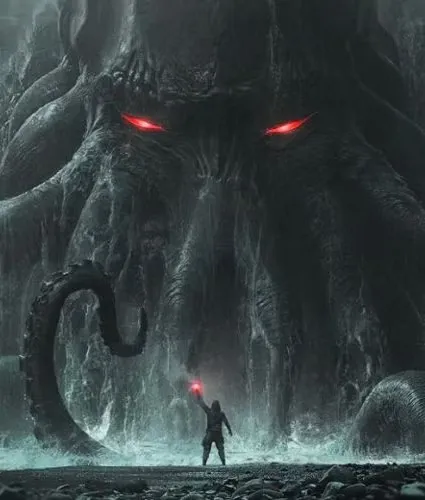
Father Cloutier, who had been turning the schoolteacher’s rhyme over in his head, asked her about the shape the children drew — the dark tree with the figures at its base. She knew the shape. She had lived beside the hill for forty years. She did not say its name. She did not look at the window again.
The cat on her lap, Beltane, opened its eyes and looked toward Broken Hill and went back to sleep.
Fog
The sun set behind the ridge of Broken Hill, and the fog came up.
It came out of the wet ground, out of last night’s flood, out of the difference between the cold air and the warming earth — Joe Harlow would have explained it that way, if anyone had asked, and no one asked. It thickened as the light failed. By the time the fire was lit and the tins of beans were open and the bottle of moonshine sat untouched between Mauricio and Clement, the camp was an island of orange in a sea of grey, and the sea was rising.
Joe Harlow sat with them. He had not gone back with Blaine. He rolled a cigarette and watched the fog and said nothing about the humming he sometimes heard at night, out of the ground, when the wind was right. He did not mention the lights he had seen on the hillside in other years. He kept his own counsel, as Vermont men did, and the silence of the hill was explanation enough.
Clement checked his pack. The head was still there. The Luger was in his jacket. The climbing gear was laid out for the morning, if the fog lifted, if any of them wanted to go up.
In town, Father Cloutier was walking back from the reverend’s house with permission for his blessing and a bag of chocolate in his coat. Susan was at the farmhouse, studying her notes on the Cutter family, the carved symbol, the swallowed acid. The sheriff’s office was quiet. Jimmy Maclearan was asleep in his cell, dreaming of flowers.
And on Broken Hill, in the dark, the survey team sat around a fire they had not asked for, on a hill that had no birds, above a pit full of the dead, and waited for a morning that Blaine had promised to return for — and the fog closed over them like a hand, and the truck sat cold and silent in the reeds at the edge of the camp with a stone in its tailpipe that none of them had found yet.
Next: The fog does not lift. The phone line at the farmhouse goes dead. And on a hill where the dead have been buried for a thousand years, something comes down out of the dark that is not a falling star.